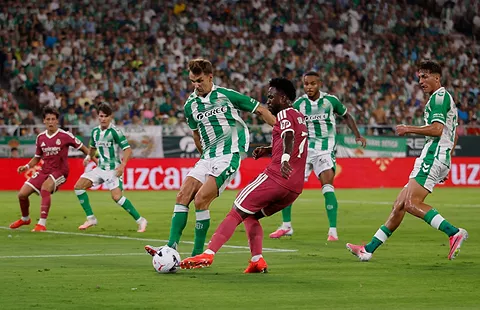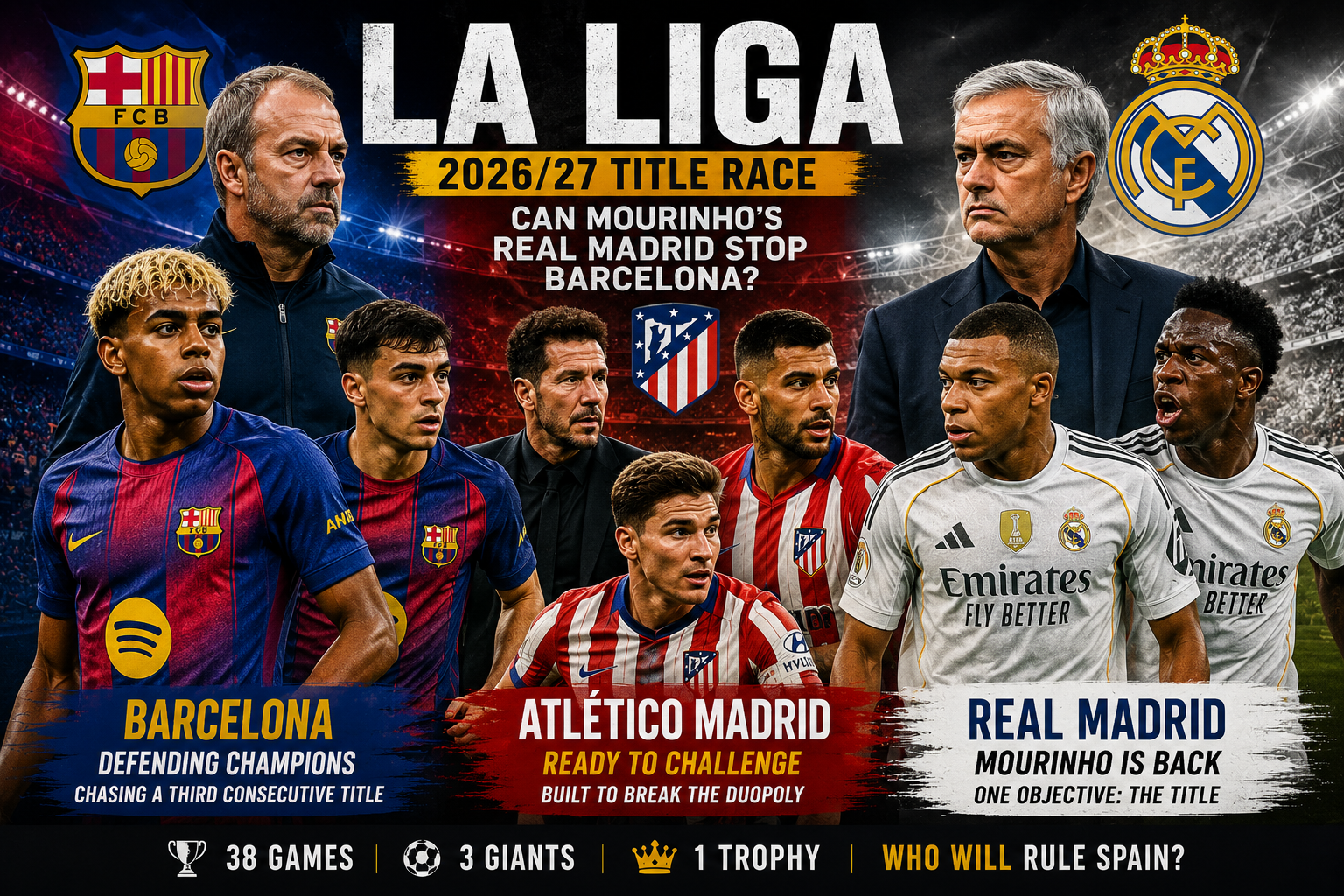
Barcelona are chasing a third consecutive La Liga title, José Mourinho’s Real Madrid are determined to reclaim the crown, and Diego Simeone’s Atlético Madrid are looking to disrupt Spain’s biggest rivalry. Who enters 2026/27 with the strongest claim to the championship?
Category: La Liga | Opinion
Date: August 16, 2026
By Abiodun Adewale Adeniyi | Founder & Editor, Beyond the Final Whistle
La Liga | 2026/27 Title Race
The La Liga 2026/27 title race promises another fascinating battle at the top of Spanish football.
Barcelona enter the season as defending champions.
Real Madrid enter it with something to prove.
Atlético Madrid enter it knowing that another campaign spent watching Spain’s two giants fight over the championship will not satisfy a club of their ambitions.
But this season has another ingredient.
José Mourinho is back at Real Madrid.
More than a decade after his first spell at the Santiago Bernabéu, Mourinho has returned with one enormous objective: restore Real Madrid to the top of Spanish football.
Waiting for him is Hansi Flick’s Barcelona.
Barça have won the last two La Liga championships and now have an opportunity to make it three consecutive titles.
That makes the central question of the new season unavoidable:
Can Real Madrid stop Barcelona from winning La Liga for a third consecutive year?
Beyond the Final Whistle examines Barcelona, Real Madrid and Atlético Madrid, the tactical questions surrounding each contender, the players who could decide the championship and our early prediction for the La Liga 2026/27 title race.
Barcelona: The Champions Everyone Has to Catch
The title race begins with Barcelona because the crown still belongs to them.
Hansi Flick has restored something that Barcelona had spent years trying to rediscover: a clear football identity combined with results.
The German’s Barça are aggressive.
They want possession, but possession is not the final objective.
They want to attack.
They press high.
They attempt to recover the ball quickly.
And when spaces appear, they have players capable of exploiting them immediately.
Most importantly, they enter the new campaign knowing exactly what it takes to survive a 38-game championship race.
That experience matters.
Winning one title can be produced by an exceptional season.
Winning consecutive championships suggests something more sustainable.
Barcelona are now attempting to make it three.
Maintaining that standard will not be easy. Defending a championship brings a different type of pressure because every rival enters the season knowing exactly who must be caught.
It is a challenge we have also examined in English football in our analysis of whether Arsenal can defend their Premier League title.
Different league.
Different circumstances.
Same fundamental question:
Can the champions respond when everyone is chasing them?
Lamine Yamal Is No Longer Just the Future
For years, football supporters have spoken about Lamine Yamal as a player destined to become one of the game’s biggest stars.
That conversation has changed.
He is no longer merely Barcelona’s future.
He is part of their present.
The extraordinary thing about Yamal is not simply his technical ability.
It is his decision-making.
Young attackers often possess spectacular talent but lack the patience required to understand when to dribble, when to pass and when to slow an attack down.
Yamal has developed those qualities remarkably quickly.
From the right, he gives Barcelona several possibilities.
He can stay wide and isolate the left-back.
He can move inside and combine.
He can create.
He can score.
And his presence can distort an entire defensive structure because opponents often need additional cover on his side.
That creates space elsewhere.
With players such as Pedri and Dani Olmo capable of exploiting those spaces, defending Barcelona becomes a problem involving much more than stopping one winger.
Mourinho will understand that better than almost anyone.
Pedri Remains Barcelona’s Controller
Spectacular forwards attract headlines.
Midfielders often determine championships.
That is why Pedri could be one of Barcelona’s most important players again.
When fit and operating at his best, Pedri gives Barça control.
He understands where space will appear before it opens.
He can receive under pressure.
He can progress possession without forcing the game.
And perhaps most importantly, he gives Barcelona rhythm.
That matters enormously over a league season.
Not every match will become an open spectacle.
There will be difficult away games.
There will be opponents defending with 10 players behind the ball.
There will be nights when Barcelona’s attackers are frustrated.
Those are often the matches where midfield intelligence becomes decisive.
But Barcelona Have Changed
Being defending champions does not mean Barcelona simply return with exactly the same team.
There have been significant changes to the squad.
That creates one of the biggest questions surrounding Flick this season.
Can Barcelona evolve without losing the tactical understanding that made them champions?
Squad turnover can be healthy.
Fresh competition prevents complacency.
New players can solve weaknesses opponents discovered during the previous campaign.
But changes can also disrupt relationships that took months to build.
That is particularly important defensively.
Flick prefers an aggressive approach.
Barcelona can defend high because they want to compress the pitch, keep opponents away from their own goal and recover possession quickly.
When the press works, it can suffocate teams.
When the press is broken, space appears behind the defence.
And Real Madrid possess exactly the type of attackers capable of exploiting that space.
Which brings us to Madrid.
Real Madrid: Mourinho Returns With a Point to Prove
There are managerial appointments.
And then there is José Mourinho returning to Real Madrid.
This is not simply another coaching change.
Mourinho’s first spell at Madrid came during one of the fiercest periods of the club’s rivalry with Barcelona.
Pep Guardiola’s Barcelona were considered one of the greatest teams ever assembled.
Mourinho was hired partly to challenge that dominance.
Now history has produced an interesting echo.
Barcelona are champions again.
Madrid are chasing again.
And Mourinho has returned.
The expectations will be enormous.
At Real Madrid, they always are.
Second place rarely represents success at the Santiago Bernabéu.
Mourinho knows that better than most.
Mourinho Doesn’t Need to Make Madrid Barcelona
This could become the tactical story of the season.
Real Madrid do not need to dominate matches exactly like Barcelona.
They need to beat them over 38 games.
Those are different objectives.
Mourinho has historically been comfortable building teams capable of controlling matches without necessarily controlling every possession.
And with the attacking speed available to Madrid, transition football could become devastating.
Imagine an opponent committing numbers forward.
Madrid recover possession.
One pass breaks the first line.
Vinícius Júnior accelerates.
Kylian Mbappé attacks the space through the middle.
Suddenly, possession statistics become irrelevant.
That is the danger Madrid can present.
Football is not only about having the ball.
It is about what you do when you have it — and what you force the opposition to do when you don’t.
That tactical distinction is something we regularly explore at Beyond the Final Whistle. Our breakdown of Liverpool’s pressing tactics shows how a team’s structure without the ball can be just as important as its attacking patterns in possession.
Mourinho’s Madrid will need its own identity.
Not Barcelona’s identity.
Not the Real Madrid of 2012.
A system designed around the players he has now.
Kylian Mbappé Could Decide the Championship
There are many extraordinary footballers in La Liga.
Few can change a match as quickly as Kylian Mbappé.
His greatest weapon is not simply speed.
It is the fear his speed creates.
Defenders begin adjusting before he even receives the ball.
Centre-backs drop deeper.
Full-backs become reluctant to advance.
Midfielders worry about losing possession.
That psychological effect changes how opponents play.
Mourinho’s challenge will be constructing a system that maximises Mbappé without making Madrid predictable.
Because Barcelona will know the threat.
So will every other team in Spain.
Knowing it exists and stopping it are two different things.
Vinícius Gives Madrid Another Elite Threat
If an opponent concentrates entirely on Mbappé, there is another problem.
Vinícius Júnior.
That gives Madrid something most clubs cannot replicate.
Two attackers capable of frightening a defence simply by running toward it.
Against deep blocks, Madrid will need creativity.
Against teams willing to attack them, they could be terrifying.
And that distinction could shape Mourinho’s tactical approach.
There may be matches when Madrid dominate possession and need patience.
There may be others where allowing an opponent to advance actually creates the conditions Madrid want.
The best version of Mourinho’s Real Madrid will need to be comfortable doing both.
Madrid’s Talent Gives Mourinho Options
Real Madrid’s squad contains extraordinary attacking and midfield talent.
Mbappé.
Vinícius.
Jude Bellingham.
Each presents a different problem.
Mbappé provides explosive movement and goals.
Vinícius provides one-on-one destruction from wide areas.
Bellingham provides midfield power, movement and the ability to arrive in attacking positions.
The challenge is balance.
How many attacking players can Madrid commit forward without becoming vulnerable when possession is lost?
How aggressive should the full-backs be?
Who protects the defence?
Who controls the tempo when a match becomes chaotic?
Those questions may ultimately determine whether Mourinho’s return ends with another La Liga trophy.
The Midfield Question Could Decide Real Madrid’s Season
Real Madrid spent years possessing something almost impossible to replace.
Control.
The greatest Madrid midfields understood when the team needed to accelerate and when a match needed to slow down.
That intelligence is essential during a 38-game season.
Madrid have enormous midfield talent, but Mourinho must establish exactly how his team controls difficult matches when transitions are unavailable.
Barcelona already possess an established positional structure under Flick.
Madrid are attempting to establish another identity under a returning manager.
That gives Barcelona an early advantage.
But if Mourinho finds the balance quickly, that advantage could disappear.
Atlético Madrid: The Dangerous Third Candidate
Every La Liga title preview eventually becomes Barcelona versus Real Madrid.
Atlético Madrid will hate that.
And perhaps they should.
Diego Simeone has already demonstrated that Spain’s duopoly can be broken.
Atlético won La Liga in 2013/14.
They did it again in 2020/21.
Those championships matter because they proved something important.
Barcelona and Real Madrid are enormously powerful.
They are not unbeatable.
But Atlético have now gone several seasons without another league championship.
The pressure is growing.
Simeone remains one of European football’s most recognisable managers, but reputation alone cannot keep Atlético in the title conversation forever.
They need another genuine challenge.
Atlético Need Their Defensive Identity
For years, Atlético’s identity was obvious.
Defensive organisation.
Aggression.
Compactness.
Counter-attacking.
Emotional intensity.
Opponents knew what was coming.
That didn’t mean they could solve it.
Modern Atlético have attempted to become more flexible.
That evolution is necessary.
The best teams cannot survive indefinitely by playing only one way.
But evolution carries a danger.
Change too much and you can lose the qualities that made you successful in the first place.
The challenge for Simeone is finding the balance.
Atlético need enough attacking quality to break down weaker opponents while retaining the defensive personality that historically made them so difficult to defeat.
The Julián Álvarez Factor
Then there is Julián Álvarez.
For Atlético, players capable of deciding tight matches are essential in a title race.
Barcelona have Yamal.
Madrid have Mbappé and Vinícius.
Atlético need their own match-winners.
Álvarez can provide goals, movement and intelligent pressing.
His versatility also gives Simeone several tactical possibilities.
He can operate centrally.
He can move around another striker.
He can participate in the press.
He can attack space.
If Atlético are going to turn a strong season into a genuine title challenge, Álvarez could become one of the most important players in Spain.
Barcelona vs Real Madrid: Where the Title Could Be Won
The obvious answer is El Clásico.
But championships are rarely that simple.
The meetings between Barcelona and Real Madrid will matter enormously.
They always do.
But Barcelona and Madrid can split the Clásicos and still have the championship decided elsewhere.
Titles are often lost in less glamorous places.
A difficult away game after Champions League football.
A 0–0 draw against a relegation candidate.
An injury crisis in February.
A red card.
A late equaliser conceded from a corner.
That is why consistency remains more important than spectacle.
The La Liga 2026/27 title race could ultimately be decided not by who wins the biggest match, but by who drops the fewest unnecessary points in the matches everyone expects them to win.
Barcelona’s Biggest Advantage: Continuity
This is where Barcelona currently have an edge.
Flick already knows his team.
His players already know his expectations.
The pressing triggers are established.
The attacking relationships exist.
The positional structure is familiar.
Madrid are beginning another managerial cycle.
Even with Mourinho’s experience, implementing ideas takes time.
That does not mean Barcelona are automatically better.
It means they begin the season further along in their tactical development.
Over the opening months, that could matter enormously.
Real Madrid’s Biggest Advantage: Individual Firepower
If Barcelona’s advantage is structure, Madrid’s is destructive individual quality.
Mbappé.
Vinícius.
Bellingham.
That is an extraordinary collection of talent.
A team can defend well for 80 minutes and still lose because one of those players produces something exceptional.
That gives Madrid a margin for error tactically.
They do not always need the perfect collective performance.
Sometimes they simply need one superstar to win the match.
Over 38 games, those moments add up.
What About the Rest of La Liga?
One mistake when discussing Spanish football is pretending only three clubs matter.
Barcelona, Real Madrid and Atlético naturally dominate the championship conversation because of their resources, squads and history.
But the rest of La Liga can determine who becomes champion.
Strong teams outside the traditional giants can take points from contenders.
Difficult away grounds can transform straightforward-looking fixtures into battles.
And every season produces teams capable of exceeding expectations.
A club does not necessarily need to win La Liga to influence the title race.
Take four points from Barcelona.
Beat Madrid at home.
Hold Atlético to a draw.
Suddenly the championship table looks different.
That is why Spain’s strongest challengers outside the traditional three should not be treated as background characters.
They can become kingmakers.
Five Players Who Could Define the La Liga 2026/27 Title Race
1. Lamine Yamal — Barcelona
The most exciting young attacking talent in Barcelona’s team and increasingly one of its central figures.
If Yamal produces another elite season, Barcelona become extremely difficult to stop.
But his importance now creates another challenge.
Expectations.
Opponents will design defensive plans specifically around him.
The next stage of his development is proving he can remain decisive even when everybody knows where the danger is coming from.
2. Kylian Mbappé — Real Madrid
Madrid’s most devastating goalscoring weapon.
Mourinho’s ability to maximise Mbappé could determine whether his return ends with a championship.
The frightening part for opponents is that Mbappé does not need many opportunities.
One defensive mistake can be enough.
3. Pedri — Barcelona
Yamal may create the highlights.
Pedri can control the matches that create championships.
Keeping him fit and influential will be crucial.
Barcelona’s attacking players become even more dangerous when Pedri dictates the rhythm behind them.
4. Jude Bellingham — Real Madrid
Bellingham gives Mourinho tactical flexibility because he can influence matches from multiple midfield positions.
His movement into attacking areas could become particularly important against deep defensive blocks.
When Madrid cannot counter-attack, Bellingham’s ability to arrive inside the penalty area provides another route to goal.
5. Julián Álvarez — Atlético Madrid
Álvarez could be the difference between Atlético merely securing another Champions League place and genuinely challenging the top two.
Goals decide close matches.
Close matches decide championships.
Atlético need Álvarez to deliver both.
The Tactical Battle: Flick vs Mourinho
This may become the most fascinating aspect of La Liga.
Hansi Flick and José Mourinho approach football differently.
Flick’s teams are generally associated with aggressive pressing, attacking intent and a willingness to defend high.
Mourinho historically places greater emphasis on controlling space, exploiting transitions and understanding exactly where an opponent is vulnerable.
That contrast could make El Clásico fascinating.
Barcelona may want the ball.
Madrid may not always mind giving it to them.
Barcelona may push their defensive line forward.
Madrid may see space for Mbappé and Vinícius.
Madrid may defend compactly.
Barcelona may use Yamal, Pedri and their positional combinations to pull that structure apart.
It becomes a tactical argument played out on the pitch.
And whichever manager solves the other’s problems first could gain a psychological advantage extending far beyond one match.
Pressing Could Become One of the Deciding Factors
Modern elite football increasingly revolves around what happens immediately after possession changes.
Can you win the ball back quickly?
Can you escape the opposition’s first press?
Can you attack before the defensive structure resets?
Barcelona want to suffocate opponents after losing possession.
Madrid possess attackers capable of punishing that aggression if they escape.
That makes the first few seconds after turnovers particularly important.
We have previously examined the mechanics of coordinated pressing in our tactical breakdown of Liverpool’s pressing system.
The personnel are different in Spain, but the principle remains:
Pressing is not simply about running.
It is about distances, triggers, positioning and collective timing.
The team that manages those moments best could gain an enormous advantage.
Can Mourinho Really Do It Again?
There is another reason this season feels significant.
Mourinho’s first Real Madrid tenure existed in the shadow of an extraordinary Barcelona team.
His Madrid eventually broke through.
The 2011/12 side won La Liga with 100 points and produced one of the most explosive championship campaigns Spanish football had seen.
But football has changed considerably since then.
So has Mourinho.
So has Real Madrid.
This cannot simply be an attempt to recreate 2012.
Nostalgia does not win championships.
Mourinho must demonstrate that his methods can evolve alongside the modern game.
If he succeeds, the story will be enormous.
If he fails, questions about whether Real Madrid looked backward rather than forward will arrive quickly.
That is the pressure surrounding his return.
Beyond the Final Whistle Prediction
So who wins La Liga 2026/27?
Right now, our choice is:
Barcelona — Champions
But only narrowly.
Barcelona begin with the strongest combination of continuity, tactical familiarity and elite young talent.
Flick has already constructed a championship-winning structure.
Yamal can decide matches.
Pedri can control them.
And the squad knows what a long title race demands.
But this should be considerably closer than the previous campaign.
Predicted Top Four
1. Barcelona — Champions
2. Real Madrid
3. Atlético Madrid
4. Villarreal
The difference between Barcelona and Madrid could ultimately come down to how quickly Mourinho establishes his midfield structure and whether Madrid can remain defensively secure while maximising their extraordinary attacking talent.
If Mourinho solves those questions early, Real Madrid can absolutely win the league.
And Atlético cannot be dismissed.
But entering the campaign, Barcelona remain the team everyone else must catch.
Why This La Liga Season Could Be Special
Spanish football has entered another fascinating period.
Barcelona have a generation of young talent capable of defining the club’s future.
Real Madrid possess enormous star power and a manager returning with something to prove.
Atlético Madrid remain led by the coach who has already demonstrated that Spain’s traditional duopoly can be broken.
And hovering above everything is the rivalry that has defined Spanish football for generations.
Barcelona.
Real Madrid.
Flick.
Mourinho.
Yamal.
Mbappé.
Camp Nou.
Bernabéu.
Another chapter is beginning.
For Beyond the Final Whistle, the beauty of the title race is not simply predicting who finishes first.
It is understanding why.
Which tactical adjustment changes a Clásico?
Which young player becomes a superstar?
Which injury alters a championship?
Which supposedly straightforward away fixture becomes the night everything changes?
Those are the stories that will shape the season.
Final Whistle
The La Liga 2026/27 title race has all the ingredients required for one of the most compelling Spanish seasons in years.
Barcelona are champions.
Real Madrid are coming for them.
Atlético Madrid are tired of being treated as spectators.
Barcelona possess continuity.
Madrid possess extraordinary individual talent.
Atlético possess an experienced manager who understands exactly what it takes to disrupt Spain’s traditional hierarchy.
Our early prediction is Barcelona to retain the title.
But this does not feel inevitable.
José Mourinho has returned to Madrid with one clear objective.
If he can organise Real defensively while giving Mbappé, Vinícius and Bellingham enough freedom to decide matches, Barcelona’s pursuit of three consecutive championships could become extremely difficult.
Atlético will be waiting for both clubs to make mistakes.
And over 38 matches, there will be mistakes.
That is what makes a title race.
Can Barcelona make it three La Liga titles in a row?
Will Mourinho restore Real Madrid to the top?
Or can Simeone and Atlético shock them both?
The battle for Spain begins again.
Join the conversation with Beyond the Final Whistle.