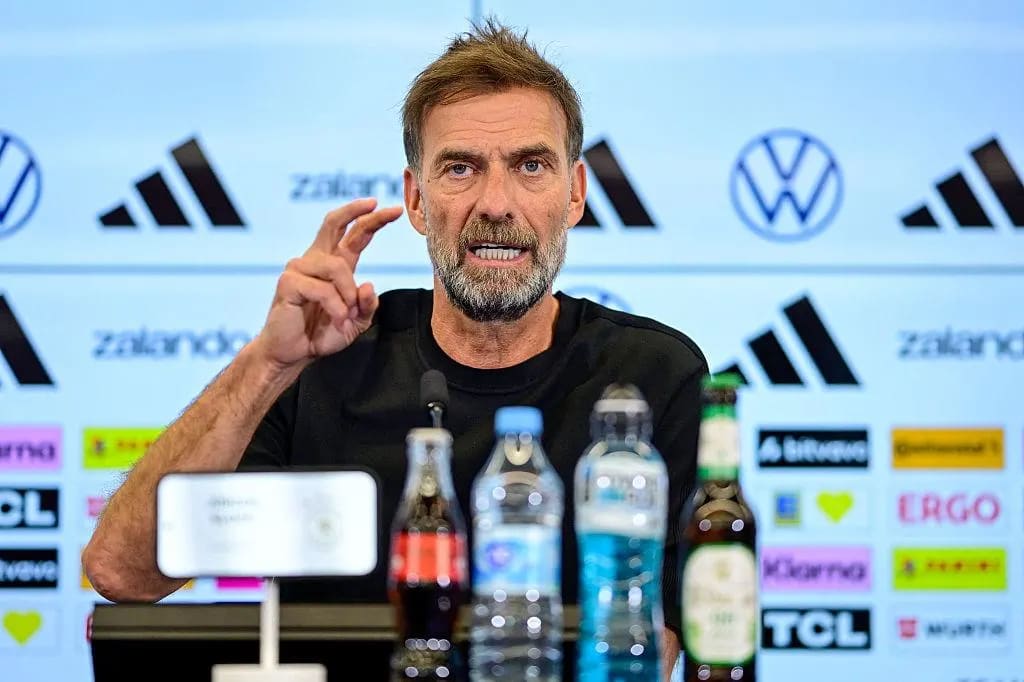
Jürgen Klopp's Germany era continues with his first home match against Greece in Augsburg. After a 1–1 draw with the Netherlands and injuries to Jamal Musiala and Kai Havertz, Germany's new coach already faces an intriguing test of how quickly he can transform the national team.
Date: September 27, 2026
By Abiodun Adewale Adeniyi | Founder & Editor, Beyond the Final Whistle
Jürgen Klopp waited years for the opportunity to manage Germany.
Now the difficult part begins.
After opening his tenure with a 1–1 draw against the Netherlands in Amsterdam, Klopp takes charge of Germany on home soil for the first time when Greece visit the WWK Arena in Augsburg tonight.
UEFA lists Germany vs Greece among Sunday's headline Nations League Matchday 2 fixtures, with Klopp still searching for his first victory as national-team coach.
But this match is about considerably more than securing Klopp's first three points.
It is an early examination of whether the football identity that made his Borussia Dortmund and Liverpool teams famous can actually be transferred to international football.
Klopp's Germany Have Already Shown Glimpses

Germany didn't win Klopp's first match.
But the new coach saw enough to believe the foundations are there.
Speaking before tonight's game, Klopp said Germany learned plenty from the Netherlands draw. He was particularly encouraged by the moments when his players defended collectively, won possession in useful areas and created counterattacking opportunities.
The problem was consistency.
Germany didn't produce those moments often enough.
Klopp acknowledged that himself in the DFB's official pre-match interview, saying Germany had promising spells in possession but needed considerably more of them.
That distinction matters.
Klopp isn't starting with a team incapable of playing his football.
He's starting with one that cannot yet play it consistently.
Can Klopp's Pressing Football Work Internationally?
This is perhaps the most fascinating question surrounding his appointment.
At Liverpool and Borussia Dortmund, Klopp had months and years to develop pressing triggers, positional relationships and automatic reactions when possession changed.
International managers don't have that luxury.
They receive players for relatively short camps before sending them back to their clubs.
That makes implementing an aggressive coordinated press considerably more complicated.
Beyond the Final Whistle has previously examined the mechanics behind Liverpool's pressing tactics, and the fundamental principle applies here too: pressing successfully isn't simply about running harder.
It requires the entire team to understand when to press, where to press and what passing options should be removed.
Klopp's challenge is compressing that education into international windows.
Musiala and Havertz Absences Complicate the Plan
Germany's preparations haven't been ideal.
Jamal Musiala and Kai Havertz are both unavailable against Greece because of injuries.
Musiala suffered a right-thigh tear after experiencing a problem during the warm-up before the Netherlands match, while Havertz sustained a muscular injury during the game.
Florian Wirtz and Jonathan Burkardt were subsequently brought into Klopp's group earlier than originally planned.
Those absences matter tactically.
Musiala provides the individual dribbling and creativity required to break organised defensive structures.
Havertz gives Germany movement across the forward line.
Against an opponent expected to defend more compactly than the Netherlands, losing both removes two players particularly capable of unlocking crowded spaces.
Florian Wirtz Suddenly Becomes Even More Important
That puts additional responsibility on Florian Wirtz.
Germany may dominate possession tonight.
If Greece defend in a compact block, Klopp will need players capable of receiving between the lines, turning under pressure and creating opportunities around the penalty area.
Wirtz is precisely that type of player.
His early arrival in the squad because of Germany's injuries could therefore become particularly important.
There is also an interesting Klopp connection.
Wirtz now plays for Liverpool, meaning he is working at the club where Klopp built one of Europe's most recognisable pressing teams.
But Germany need more than familiarity with Klopp's ideas.
They need execution.
Greece Are Not Coming to Augsburg as Tourists
Germany should not mistake this for an easy first home assignment.
Greece opened their Nations League campaign with a 2–1 victory over Serbia, while Germany managed only a point against the Netherlands. UEFA's Matchday 2 preview notes that Serbia had actually taken a fourth-minute lead before Greece recovered to win.
Klopp has been particularly complimentary about tonight's opponents.
After analysing Greece, he described them as possessing a highly talented generation with quality throughout the team and praised their development under their coach.
His conclusion was straightforward: Germany will have to work extremely hard to win.
That sounds like typical respect for an opponent.
But tactically, there is a genuine problem for Germany to solve.
Germany May Face a Completely Different Match
Jonathan Tah expects Greece to approach the game differently from the Netherlands.
The German centre-back believes the visitors are likely to defend more deeply and attack on the counter.
That could tell us more about Klopp's Germany than the Netherlands game did.
Klopp's best club teams were devastating when opponents tried to play through them.
Winning possession high up the pitch immediately created opportunities.
But breaking down a compact defence requires something different.
Patience.
Positional creativity.
Width.
Movement between defensive lines.
And players capable of producing something unexpected when the system alone cannot create an opening.
Without Musiala, that becomes more difficult.
Klopp Makes a Goalkeeping Change
There will also be a change behind Germany's defence.
Klopp has confirmed that Alexander Nübel will start against Greece.
Importantly, the coach stressed that the decision isn't punishment for Marc-André ter Stegen's performance against the Netherlands.
Klopp actually defended Ter Stegen strongly, saying criticism of the goalkeeper surprised him and describing his performance in Amsterdam as outstanding.
Nübel's opportunity is instead part of Klopp's early evaluation of his squad.
That fits into a much broader experiment.
Klopp selected 44 players across two squads for Germany's opening four Nations League matches, an unusual approach designed to evaluate a large group while reducing the burden on individual players during an already congested season. Reuters reported that the strategy received public support from figures including Lothar Matthäus and DFB vice-president Hans-Joachim Watzke.
Klopp Isn't Just Looking for a Starting XI
That 44-player decision reveals something important about the new Germany coach.
Klopp isn't simply trying to win four Nations League games.
He is collecting information.
Germany's disappointing early exit from the 2026 World Cup created the need for another rebuild, and Klopp has time before Euro 2028 to determine which players actually fit his football.
The DFB's announcement of Klopp's first squads confirms that most players selected for the Netherlands and Greece fixtures will return to their clubs before a different group takes over for Serbia and the return match against Greece.
That is essentially an international audition involving almost two complete squads.
And tonight provides another set of evidence.
Germany's Home Record Against Greece Offers Encouragement
History heavily favours Germany.
According to the DFB's official Germany vs Greece match guide, the countries have met ten times.
Germany have never lost.
Their record stands at seven victories and three draws.
The most recent meeting came in June 2024, when Germany won 2–1, while their most famous encounter remains the 2012 European Championship quarter-final, which Germany won 4–2.
But history won't press Greece tonight.
Klopp's players have to do that themselves.
Augsburg Gets Klopp's First Germany Home Match


There is another reason tonight matters.
This is Klopp's first home match as Germany coach.
The WWK Arena in Augsburg holds around 30,660 spectators, and the German national team hasn't played an international there for a decade.
Klopp has spoken about wanting Germany's home atmosphere to become an advantage again.
For a manager whose Liverpool and Dortmund teams were so closely associated with emotionally charged stadiums, that relationship between team and supporters shouldn't be underestimated.
International football gives him fewer opportunities to build it.
Tonight is the first.
What Would Progress Actually Look Like?
The scoreboard matters.
Klopp wants his first victory.
But the performance may tell us considerably more about where Germany are heading.
Can Germany press collectively rather than as individuals?
Can they recover possession and immediately attack?
Can they control a team that sits deeper?
Can Wirtz compensate for some of the creativity lost with Musiala?
Can Germany remain defensively secure while committing numbers forward?
And, perhaps most importantly, can the players begin reacting instinctively to Klopp's demands rather than thinking about every instruction?
Those are the signs worth watching.
Germany vs Greece Is an Early Test of the Klopp Project
Germany don't need to become Klopp's Liverpool overnight.
That would be unrealistic.
International football simply doesn't provide enough training time for that.
But Germany hired Klopp because they wanted more than a change of manager.
They wanted an identity.
The Netherlands match provided the first glimpse.
Greece provides the second test.
And because the tactical challenge is different, tonight may actually teach Klopp more about his team than his debut did.
Germany will have more of the ball.
They will be expected to attack.
They will be expected to win.
Now we find out what Klopp's Germany can do when the opponent asks them to create rather than react.
Beyond the Final Whistle, Jürgen Klopp's first Germany victory will eventually arrive, but the more important question is whether a recognisable identity arrives with it. The draw against the Netherlands showed flashes of the collective pressing and transition football associated with Klopp's best teams. Against a Greece side likely to defend deeper, Germany must demonstrate another dimension: patience, creativity and the ability to control a match when the responsibility to attack belongs to them.
Can Klopp celebrate his first Germany victory in front of the home supporters, or will Greece expose how much work remains before his football truly takes hold? Join the conversation on Beyond the Final Whistle.