
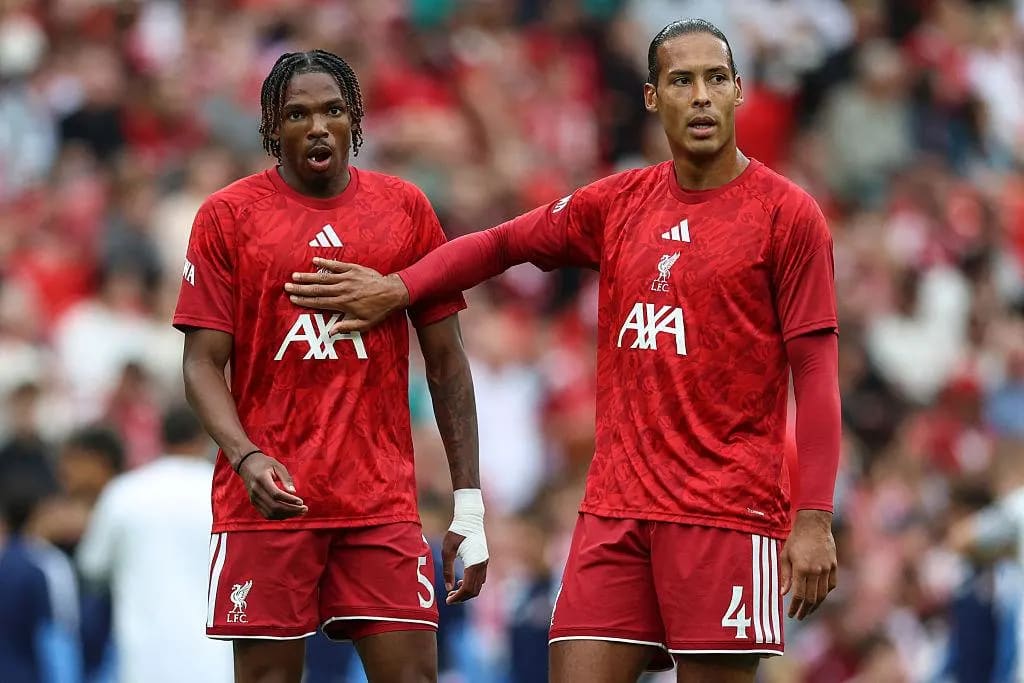
Liverpool took a £60 million gamble on Jérémy Jacquet after just 33 senior appearances for Rennes. Months later, the 21-year-old is starting alongside Virgil van Dijk, winning praise from Zinedine Zidane and forcing his way into the France team. Did Liverpool identify their defensive future before the rest of Europe realised how good he could become?
By Abiodun Adewale Adeniyi | Founder & Editor, Beyond the Final Whistle
October 4, 2026 | Jérémy Jacquet / Liverpool / France
Sixty million pounds.
For a 20-year-old centre-back with only 33 senior appearances for Rennes, the number immediately invited questions.
Too much?
Too soon?
Too risky?
Liverpool saw something different.
They saw one of Europe's most promising young defenders — and perhaps a player capable of eventually assuming one of the most difficult responsibilities at Anfield.
Replacing Virgil van Dijk.
Liverpool officially completed Jérémy Jacquet's move from Rennes in July after agreeing the transfer earlier in 2026.
The Frenchman arrived with considerable potential but limited experience.
Three months later, the conversation has already changed.
Jacquet has established himself alongside Van Dijk.
He has been voted Liverpool's Player of the Match.
He has broken into the France senior team.
And after only his second international appearance, Zinedine Zidane could barely stop praising him.
Liverpool may have spent £60 million on potential.
They increasingly look as though they bought something much closer to the finished product.
Liverpool Were Planning for Life After Van Dijk
Every great team eventually faces an uncomfortable question.
What happens when the player who defines an entire area of the pitch begins approaching the end of his career?
For Liverpool, that question surrounds Van Dijk.
The Dutchman has been the foundation of Liverpool's defence for years.
His leadership.
Positioning.
Aerial dominance.
Recovery speed.
Passing range.
Calmness under pressure.
Replacing all of that with one signing may be impossible.
Liverpool therefore could not afford to wait until Van Dijk was gone before beginning the succession process.
Jacquet represents preparation rather than panic.
He arrived young enough to develop alongside Van Dijk rather than being immediately burdened with replacing him.
That distinction matters.
Jacquet can watch.
Learn.
Make mistakes.
Develop.
And gradually assume greater responsibility.
In fact, Jacquet has openly described Van Dijk as the defender he studied growing up.
Liverpool's own Jacquet factfile quoted the Frenchman explaining that if he wanted to reach the highest level, he needed to absorb as much as possible from Van Dijk.
Now his role model is standing beside him.
There may be no better classroom for an aspiring elite centre-back.
Liverpool's £60m Gamble Already Looks Different
The transfer fee initially made Jacquet's signing look risky.
Liverpool were paying elite-defender money for potential.
But recruitment should not simply be judged by what a player is worth on the day he signs.
Elite recruitment attempts to predict what a player will become.
Liverpool's scouts believed Jacquet's ceiling justified the investment.
Sky Sports reported that Liverpool invested around £60 million in the defender after Ibrahima Konaté's departure created a more immediate opening in the back line.
That accelerated Jacquet's pathway.
He was no longer simply a prospect being prepared for the future.
Liverpool needed him.
And so far, he has responded.
The Numbers Liverpool Saw in France Were Already Exceptional
Jacquet's final season in France contained several indicators of why Liverpool were willing to invest so heavily.
According to Opta figures published by Liverpool, he won 75.5% of his aerial duels per 90 minutes during the 2025/26 Ligue 1 campaign.
That ranked third in the division.
He also won 62% of his ground duels.
But perhaps the most interesting number was his passing.
90.4%.
Jacquet completed 973 of 1,076 passes.
That matters enormously for Liverpool.
Modern centre-backs are no longer judged simply on tackling, heading and clearances.
They initiate attacks.
They break pressing lines.
They invite opposition pressure before finding midfielders.
They sometimes become the first playmaker in possession.
Jacquet's background helps explain his comfort with the ball.
He was originally a midfielder.
Paul Pogba was one of his inspirations.
Rennes eventually convinced him that his future belonged at centre-back.
The midfielder never completely disappeared.
You can still see him when Jacquet receives possession.
He Doesn't Defend Like a Passive Centre-Back
Jacquet's personality is another important part of his game.
He likes defending forward.
Instead of continually retreating towards his own penalty area, he is comfortable stepping out of the defensive line to challenge attackers.
That aggressiveness carries risk.
Mistime the challenge and space opens behind you.
But when executed properly, it allows Liverpool to keep opponents further from goal and regain possession earlier.
That becomes especially valuable for a team expected to dominate territory.
Liverpool do not want their centre-backs permanently defending their own penalty area.
They want them participating in the press.
Jacquet's willingness to move aggressively towards opponents makes him naturally suited to that responsibility.
And his athleticism provides a degree of insurance when the defensive line moves higher.
France Have Already Seen Enough
Club football provided the first evidence.
International football has strengthened the case.
Jacquet received his first senior France opportunity during this international window.
He started against Belgium.
France won 1–0.
Days later, he started again against Italy.
France drew 1–1.
Two caps.
Two starts.
And an extremely impressed Zinedine Zidane.
After the Italy match, Zidane described Jacquet's performance as “very, very good”, highlighting his bravery and strength in duels.
Liverpool's official report on Zidane's reaction captured just how enthusiastic the France manager was about the young defender.
This is important because France do not lack centre-backs.
Competition is fierce.
Breaking into that squad at 21 is difficult.
Starting consecutive matches is even more significant.
Jacquet is not simply being included for development.
Zidane is already trusting him.
His France Breakthrough Changes the Conversation
Liverpool knew they had signed a talented young defender.
But international recognition accelerates reputation.
Perform well in the Premier League and people notice.
Perform well for France and the entire European football audience begins paying attention.
That is exactly what is happening.
Jacquet's first France appearance came during a 1–0 victory over Belgium in which Zidane made nine changes, illustrating the extraordinary depth available to the French national team.
His second appearance demonstrated that the first was not simply an experiment.
Zidane selected him again.
And praised him again.
The question surrounding Jacquet is therefore changing rapidly.
It is no longer:
Can he handle this level?
It is becoming:
How high is his ceiling?
The Bournemouth Performance Was Another Important Moment
Young defenders inevitably experience scrutiny after expensive transfers.
Every mistake is magnified.
Every performance becomes part of the debate surrounding the transfer fee.
Jacquet produced one particularly important statement against Bournemouth.
Liverpool won 1–0.
They kept a clean sheet.
And supporters voted Jacquet their Player of the Match.
Liverpool confirmed the supporter vote after the victory.
That kind of recognition matters.
Supporters do not care what scouts projected.
They care what happens on the pitch.
Jacquet is beginning to earn their trust.
Playing Beside Van Dijk Could Accelerate Everything
Liverpool have created almost an ideal development environment.
Jacquet does not need to become Van Dijk tomorrow.
He gets to play beside him today.
That means he can learn details that are difficult to teach through coaching alone.
When to step forward.
When to drop.
How to organize the defensive line.
How to control the tempo from centre-back.
How to deal with Premier League forwards physically without constantly committing fouls.
How to remain composed after making a mistake.
And perhaps most importantly, how to lead.
Van Dijk's greatest contribution to Jacquet's development may eventually have little to do with tackling or passing.
It may be teaching him how an elite centre-back controls everyone around him.
But Jacquet Is Not Van Dijk — And Liverpool Shouldn't Want Him to Be
Comparisons are inevitable.
They can also become unfair.
Van Dijk is one of the defining defenders of his generation.
Expecting Jacquet to reproduce his career simply because they play the same position at the same club would be unreasonable.
Liverpool should instead focus on developing Jacquet's own strengths.
His front-foot aggression.
His passing.
His ability to carry possession.
His athleticism.
His comfort defending higher up the pitch.
His willingness to take responsibility.
The objective should not be creating another Van Dijk.
It should be developing another elite Liverpool centre-back.
Those are not necessarily the same thing.
His Arrival Also Represents Liverpool's Wider Evolution
Liverpool's squad is changing.
Older pillars cannot remain forever.
New players must eventually inherit responsibility.
That transition becomes even more complicated because Liverpool are expected to compete simultaneously for domestic trophies and in Europe.
As we explained in our Champions League 2026/27 guide to the teams, format and key dates, the modern European calendar places enormous demands on squads attempting to challenge on multiple fronts.
Defensive depth is therefore not a luxury.
It is essential.
Liverpool cannot ask Van Dijk to carry the defence indefinitely.
Jacquet gives them another player capable of taking meaningful responsibility now while potentially becoming even more important later.
That is exactly the kind of succession planning elite clubs need.
Chelsea's Interest Makes Liverpool's Decision Even More Interesting
Liverpool were not alone in recognizing Jacquet's potential.
Chelsea were also interested.
That should not be surprising.
Chelsea's recruitment strategy has repeatedly targeted young players with elite physical and technical potential.
Jacquet fits that profile perfectly.
But Liverpool won the race.
That becomes particularly interesting when considering Chelsea's own ambitions.
We have already examined whether Chelsea can genuinely win the Premier League this season, and squad construction remains central to that question.
A defender such as Jacquet would have fit naturally into Chelsea's long-term project.
Instead, Liverpool secured him.
If Jacquet develops into one of Europe's best defenders, beating a direct Premier League rival to his signature will look increasingly significant.
From 33 Rennes Appearances to Anfield
Jacquet's rise has happened remarkably quickly.
He developed in Rennes' academy.
He spent time on loan at Clermont Foot.
He returned to Rennes.
He established himself.
Liverpool moved.
At the time of his transfer, he had made only 33 senior appearances for Rennes, according to Liverpool's official announcement.
That is a tiny sample compared with most £60 million defenders.
Liverpool were therefore buying projection.
They were betting on their scouting.
Their data.
Their coaching.
And the player's personality.
It was a significant risk.
But sometimes waiting for absolute certainty means arriving too late.
Once a young defender proves beyond doubt that he is elite, every major club wants him.
And the price becomes enormous.
Liverpool chose to move before that point.
The Leny Yoro Connection Shows How Long Liverpool Were Watching
One of the most fascinating elements of the story is how Liverpool reportedly discovered Jacquet.
According to reporting on Liverpool's recruitment process, conversations surrounding another highly rated French defender — Leny Yoro — helped place Jacquet firmly on Liverpool's radar.
Liverpool continued monitoring him.
His development accelerated.
Eventually, Jacquet became the priority.
That tells us something important about elite recruitment.
Transfers are rarely isolated decisions.
Clubs build databases of players years before they need them.
One scouting assignment leads to another player.
One failed transfer creates another opportunity.
The public sees the announcement.
Recruitment departments may have been working on the decision for years.
Jacquet appears to be a perfect example.
Could Jacquet Become One of Liverpool's Best Recruitment Decisions?
It is far too early to answer that definitively.
He is 21.
He has barely begun his Liverpool career.
Premier League football has a habit of exposing weaknesses eventually.
Opponents will study him.
Managers will target him.
Difficult periods will come.
That is normal.
What matters is how Jacquet responds when they do.
But Liverpool already have several encouraging signs.
He looks physically capable of handling the league.
He is comfortable in possession.
He has earned the trust of his teammates.
Supporters are responding to him.
And France have already promoted him into senior international football.
Those are significant milestones for a player who only arrived this summer.
The Biggest Test Is Still Coming
Early success creates expectations.
Now Jacquet must sustain it.
Opposition analysts will identify tendencies.
Premier League forwards will test his aggression.
Champions League opponents will punish positioning mistakes.
Fixture congestion will test his body.
And playing beside Van Dijk will eventually turn into playing without Van Dijk.
That final transition will tell us most.
It is one thing to perform alongside an experienced defensive leader.
It is another to become the defensive leader yourself.
Liverpool's long-term bet is that Jacquet can eventually make that transition.
Liverpool May Have Bought the Future Before They Needed It
The best succession plans are completed before the succession becomes urgent.
Liverpool could have waited.
They could have squeezed another season from the existing defensive structure and addressed the future later.
Instead, they invested heavily in a young centre-back while Van Dijk was still available to guide him.
That may prove crucial.
Jacquet does not have to learn Liverpool's expectations while simultaneously being asked to replace one of the club's greatest modern defenders.
He can prepare for that responsibility gradually.
£60 million initially looked like the price Liverpool paid for potential.
If Jacquet's opening months are an indication of what comes next, it may eventually look like the price Liverpool paid to avoid a defensive crisis before it happened.
The Van Dijk Successor Question May Already Have an Answer
Nobody should declare Jacquet the next Van Dijk after a handful of matches.
That would be unfair to both players.
But Liverpool did not spend £60 million without thinking about the future.
They knew Van Dijk could not remain the centre of their defence forever.
They needed someone with the physical profile, technical ability and personality to eventually accept greater responsibility.
Jacquet increasingly looks like that player.
France have noticed.
Zidane has noticed.
Liverpool supporters have noticed.
And perhaps most importantly, Jacquet himself does not appear overwhelmed by any of it.
The player Liverpool bought for tomorrow is already making a serious impact today.
Beyond the Final Whistle, Liverpool's £60 million investment in Jérémy Jacquet increasingly looks less like an expensive gamble and more like deliberate succession planning. His aerial strength, composure in possession, aggressive defending and rapid rise into Zinedine Zidane's France team suggest Liverpool identified an elite defensive profile before Jacquet had accumulated elite-level experience. Virgil van Dijk remains the standard at Anfield, but Liverpool may already have placed his eventual successor beside him.
Can Jérémy Jacquet eventually become Liverpool's defensive leader after Virgil van Dijk — or is it still far too early to place that responsibility on the 21-year-old? Join the conversation on Beyond the Final Whistle.


