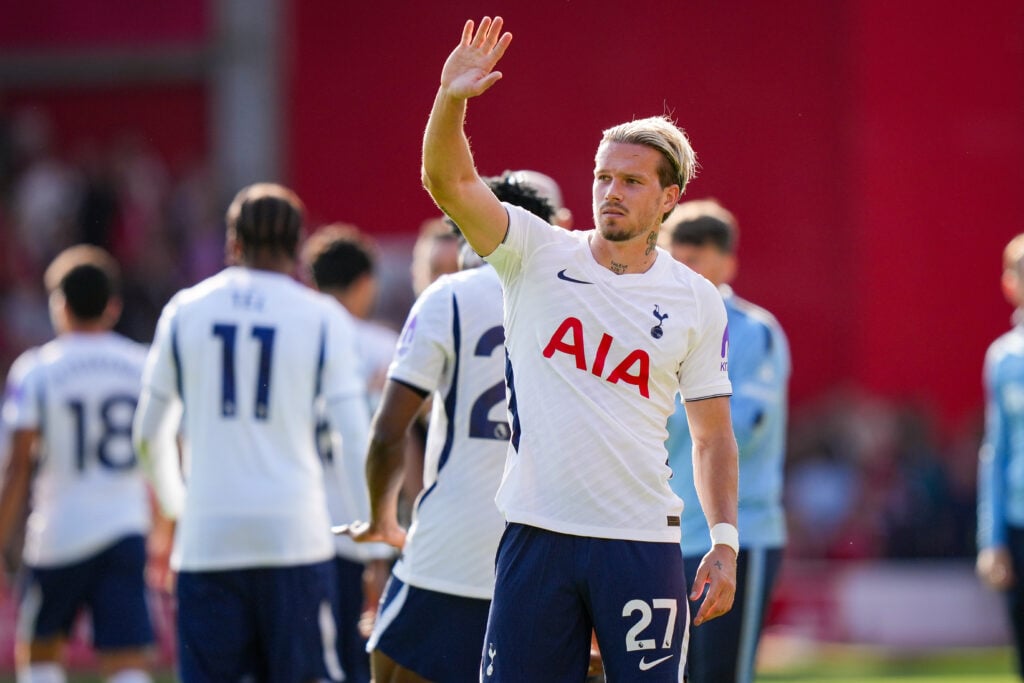
Mykhailo Mudryk has pointed the finger directly at Ukraine's national team for the failed drugs test that wiped out almost two years of his career, telling an interviewer the banned substance could only have entered his body on international duty.
The 25-year-old winger, on a season-long loan at Tottenham from Chelsea, was suspended from November 2024 until July 2026 after meldonium was found in a sample taken in October 2024. He initially faced a four-year ban from the Football Association before a successful appeal to the Court of Arbitration for Sport allowed him to return after accepting a breach and a suspension equal to the time he had already served.
"It could only have got into my body in Ukraine"
Speaking on the Ukrainian YouTube channel Guest of Gordon, Mudryk was asked who he blamed for his absence. "The environment, the situation in the Ukrainian national team," he replied, as reported by BBC Sport. "It should never have existed. I probably haven't said it publicly yet, but I'm saying it now."
"I had never heard of a drug like meldonium. It is a drug you can only get in Eastern Europe. It could only have got into my body in Ukraine. There is no such drug in England." Asked specifically whether he blamed the national team, he answered: "Yes, exactly."
Mudryk also accused Ukrainian Association of Football president Andriy Shevchenko of offering little support, blamed the association for leaks during the case and claimed its handling delayed his return. BBC Sport has contacted the UAF for comment; last year a spokesperson said the association was in close contact with Mudryk's lawyers but had not been contacted by the FA about the case.
The little cup in camp
The most startling detail concerned how supplements are handled in camp. "The Ukrainian national team has absolutely no security system," Mudryk said in the account carried by Livescore. "In the Ukrainian national team we have a nutritionist who hands us pills every couple of days before games. He brings us a little cup. Everyone has to take the pills that are in that cup."
He described the positive test itself as "a bolt from the blue", adding: "It was like falling off a skyscraper. In a dream you would hit the ground. In life, I just kept on falling. It hit me very hard, mentally." He said he cried and drank alcohol after the initial suspension, and spent millions of pounds on legal fees, coaching, pitch hire and private physiotherapy while unable to access services at Chelsea, the club he joined in January 2023 for an initial £62 million that could rise to £89 million.
What it means for Tottenham and Chelsea
Mudryk returned with Chelsea on their pre-season tour of Asia before joining Tottenham on deadline day, reuniting with his former Shakhtar Donetsk manager Roberto De Zerbi. Chelsea boss Xabi Alonso, he said, told him to go and get minutes and come back: "I am counting on you." So far the loan has brought just one substitute appearance, after what De Zerbi called a "stupid" ankle injury in training, though he is hoped to be back this weekend against Ipswich.
For Tottenham, a fully fit Mudryk is a £62 million talent on loan wages; for Chelsea, every strong performance rebuilds the value of an asset the ban froze. On a night when Chelsea's women went top of the Champions League and another former Blue, Mata, announced his retirement, Mudryk's words were a reminder that his story is still being written — and that his fight has now moved from the courtroom to his own federation.
Beyond the Final Whistle: Mudryk's accusation is extraordinary because it names a system, not a mistake — pills in a cup, no security, no support. Whether the UAF answers or stays silent, a player who lost 20 months of his prime deserves a public explanation, and Ukraine's camp protocols will now be judged in the open.
Do you believe Mudryk — should Ukraine's federation answer for the ban, or does the responsibility always stop with the player? 👇