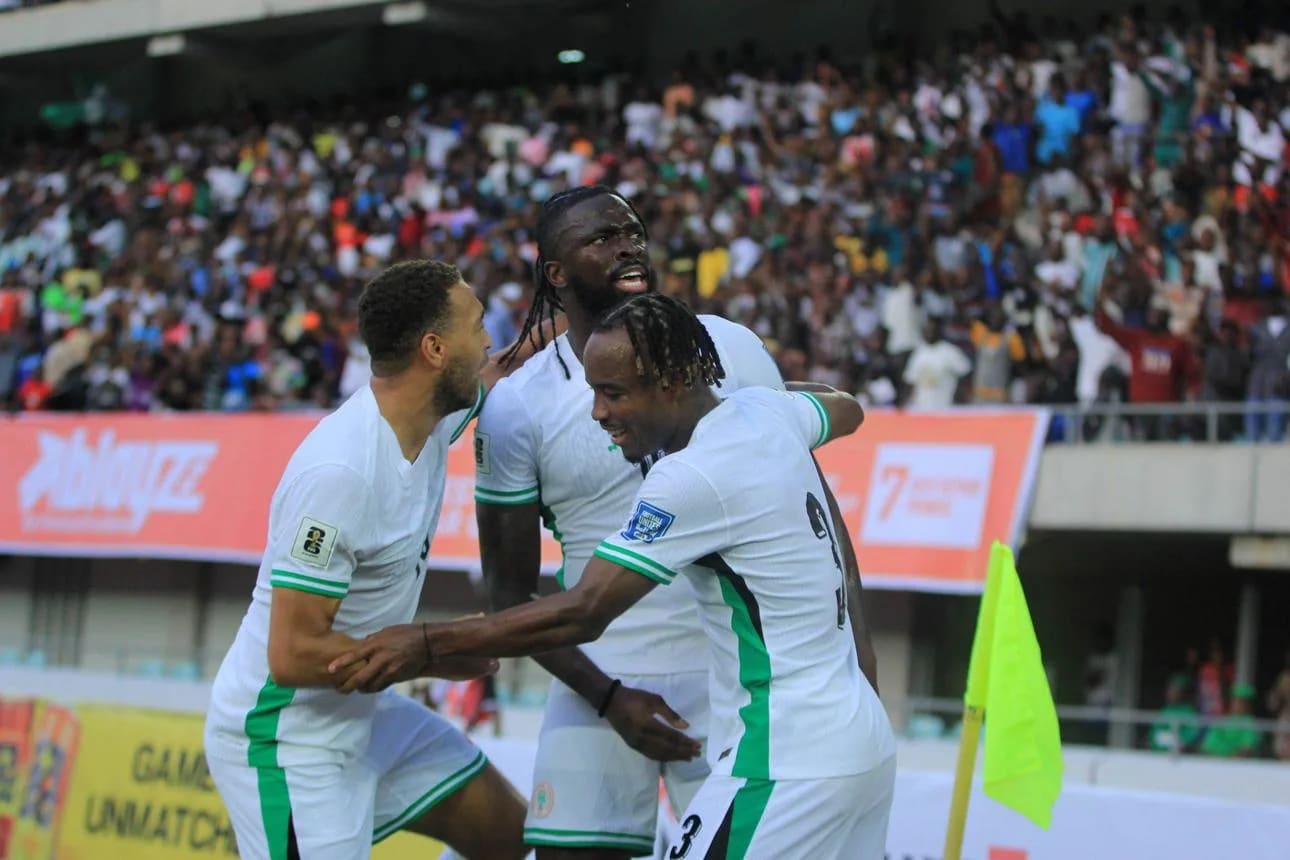
Nigeria opened their 2027 Africa Cup of Nations qualifying campaign with a 2–1 victory over Madagascar, overcoming the absence of Victor Osimhen as George Ilenikhena's first Super Eagles window offered another glimpse of the exciting young talent emerging around Eric Chelle's squad.
Date: September 25, 2026
By Abiodun Adewale Adeniyi | Founder & Editor, Beyond the Final Whistle
Nigeria have started their journey towards the 2027 Africa Cup of Nations with three points.
The Super Eagles defeated Madagascar 2–1 in their opening Group L qualifier, an important result in a section where there is unusually little margin for error.
For Eric Chelle, however, the result was about more than simply winning the opening match.
Nigeria entered the international window without their leading striker, Victor Osimhen, forcing Chelle to explore other attacking options.
One of the most intriguing was George Ilenikhena.
The 20-year-old striker received his first senior Nigeria call-up for this international window, joining a Super Eagles squad already containing established attackers such as Ademola Lookman, Samuel Chukwueze and Akor Adams. CAF confirmed Ilenikhena as one of three players receiving their first senior call-ups alongside Arthur Okonkwo and Isaac James.
And with Osimhen unavailable, Nigeria suddenly had an opportunity to discover just how deep their attacking options really are.
Nigeria Get the Three Points They Needed
Opening matches in international qualification can be uncomfortable.
Nigeria know that better than most.
The Super Eagles have experienced difficult qualifying campaigns in recent years, and avoiding another slow start was essential.
Madagascar were never likely to make things easy.
But Nigeria ultimately secured the 2–1 victory, giving Chelle's team the start they needed before their second qualifier away from home.
The significance of those three points becomes clearer when the unusual structure of Group L is considered.
Nigeria have been drawn alongside Madagascar, Guinea-Bissau and Tanzania.
But Tanzania are one of the three co-hosts of AFCON 2027, alongside Kenya and Uganda, and therefore qualify automatically.
According to CAF's official explanation of the AFCON 2027 qualifying format, only the highest-ranked team outside Tanzania will qualify from Group L.
Effectively, Nigeria are fighting Madagascar and Guinea-Bissau for one available qualification position.
Every point matters.
George Ilenikhena Represents Nigeria's Next Generation
One of the most interesting aspects of this international window has been Ilenikhena's arrival.
The young forward has already experienced Champions League football and scored notable goals at club level despite still being at the beginning of his senior career.
CAF included Ilenikhena among its 10 young players to watch during the AFCON 2027 qualifiers, noting that he had already scored Champions League winners against Barcelona for both Royal Antwerp and Monaco before moving to Saudi Arabia in 2026.
That pedigree explains why Chelle wanted to see him in the senior Nigerian environment.
But Ilenikhena isn't the only young Nigerian trying to establish himself.
The Super Eagles are gradually developing a group of players capable of forming the next generation of the national team.
One of them is defender Benjamin Fredrick, whose remarkable journey from Kaduna to Premier League football we recently explored in our Beyond the Final Whistle Player Spotlight on Benjamin Fredrick.
Fredrick was also included among Chelle's defensive options for these qualifiers.
The emergence of players such as Fredrick and Ilenikhena gives Nigeria something potentially more valuable than one successful international window: competition for places.
Life Without Victor Osimhen
Nigeria's biggest pre-match concern was obvious.
How would the Super Eagles cope without Osimhen?
The striker was initially included in Chelle's squad before injury ruled him out of the matches against Madagascar and Guinea-Bissau.
The Confederation of African Football confirmed Osimhen's absence after the striker suffered a muscle problem while playing for Galatasaray.
CAF records Osimhen as having 35 goals in 52 Nigeria appearances, demonstrating just how significant his absence is.
Replacing that production isn't easy.
But Nigeria should not try to find another Osimhen.
Instead, Chelle needs to develop different attacking solutions.
Ilenikhena offers youth, movement and finishing potential. Akor Adams provides another centre-forward option, while Lookman and Chukwueze give Nigeria threats from wider positions.
CAF also confirmed that Tolu Arokodare and Moses Usor were among Chelle's attacking selections for this window.
The objective should be to create a system capable of winning matches regardless of which striker is available.
That is what squad depth is supposed to provide.
Eric Chelle Is Building Competition Across the Squad
Perhaps the most encouraging development is that competition isn't limited to attack.
Stanley Nwabali and Maduka Okoye now have Arthur Okonkwo competing for a place among the goalkeepers.
In defence, Chelle's squad included experienced internationals such as Calvin Bassey, Ola Aina and Bright Osayi-Samuel, alongside younger players including Fredrick, Isaac James, Emmanuel Fernandez and Chibuike Nwaiwu.
Midfield still contains familiar figures in Wilfred Ndidi, Alex Iwobi and Frank Onyeka.
The combination gives Chelle an interesting balance.
Nigeria still possess experienced players capable of handling major international matches, but younger footballers are increasingly pushing for opportunities.
That competition could become crucial over a long qualification campaign.
Nigeria Cannot Afford Complacency
Victory over Madagascar is valuable, but it should not lead to complacency.
Group L's qualification structure makes every match important.
Tanzania's automatic qualification means Nigeria cannot simply rely on finishing second and progressing in the usual manner.
CAF describes the battle between Nigeria, Madagascar and Guinea-Bissau as effectively a three-way contest for the highest-ranked non-host position.
That increases the importance of beating direct rivals.
Nigeria have accomplished the first part against Madagascar.
Now they must build on it.
Guinea-Bissau Comes Next
There is little time to celebrate.
Nigeria's next assignment is an away match against Guinea-Bissau on September 29.
CAF's official fixture schedule lists Guinea-Bissau against Nigeria for 16:00 GMT, four days after the Madagascar match.
That could be a very different test.
Playing away from home in African qualification regularly demands patience, physical resilience and defensive concentration.
It will also give Chelle another opportunity to assess his attacking options without Osimhen, who has already been ruled out of the second qualifier as he continues recovering from his muscle injury.
Another victory would put Nigeria in a strong early position.
More importantly, it would demonstrate that the Super Eagles are learning how to navigate qualification without becoming completely dependent on one player.
A Bigger Super Eagles Squad Is Beginning to Take Shape
Nigeria will always want Victor Osimhen available.
A striker with his international scoring record and presence cannot simply be dismissed as replaceable.
But successful national teams need alternatives.
That is why this international window could eventually prove significant.
George Ilenikhena has entered the senior setup. Benjamin Fredrick continues his development as one of Nigeria's promising young defenders. Other younger players are pushing established internationals for places.
The result against Madagascar delivered the immediate objective.
The longer-term objective is creating a Super Eagles squad deep enough to compete regardless of injuries, suspensions or changes in form.
That process is only beginning.
But Nigeria's opening victory represents a positive first step.
Beyond the Final Whistle, Nigeria's 2–1 victory over Madagascar delivered the three points Eric Chelle needed, but the bigger story may be the growing competition inside the Super Eagles squad. With George Ilenikhena joining emerging talents such as Benjamin Fredrick and established stars still forming the core of the team, Nigeria have an opportunity to build a deeper and more adaptable side on the road to AFCON 2027.
Can Nigeria's emerging generation turn increased competition for places into a Super Eagles team capable of challenging for AFCON 2027? Join the conversation on Beyond the Final Whistle.