Croatia have spent years defying predictions of decline, but a record 7–0 defeat to England has reopened the most uncomfortable question surrounding one of international football’s great modern teams: how much longer can Luka Modrić and Croatia keep turning back time?
By Abiodun Adewale Adeniyi | Founder & Editor, Beyond the Final Whistle
October 4, 2026 | Croatia / UEFA Nations League
Luka Modrić has experienced almost everything international football can offer.
World Cup finals.
World Cup heartbreak.
Penalty shootout drama.
Historic victories.
Individual recognition.
Two decades representing his country.
But after Croatia suffered the heaviest defeat in their history, the captain used a word rarely associated with the national team he has helped transform.
Ashamed.
Croatia were demolished 7–0 by England in Rijeka on Saturday as Harry Kane and Bukayo Saka scored twice each, while Anthony Gordon, Jude Bellingham and Morgan Rogers also found the net.
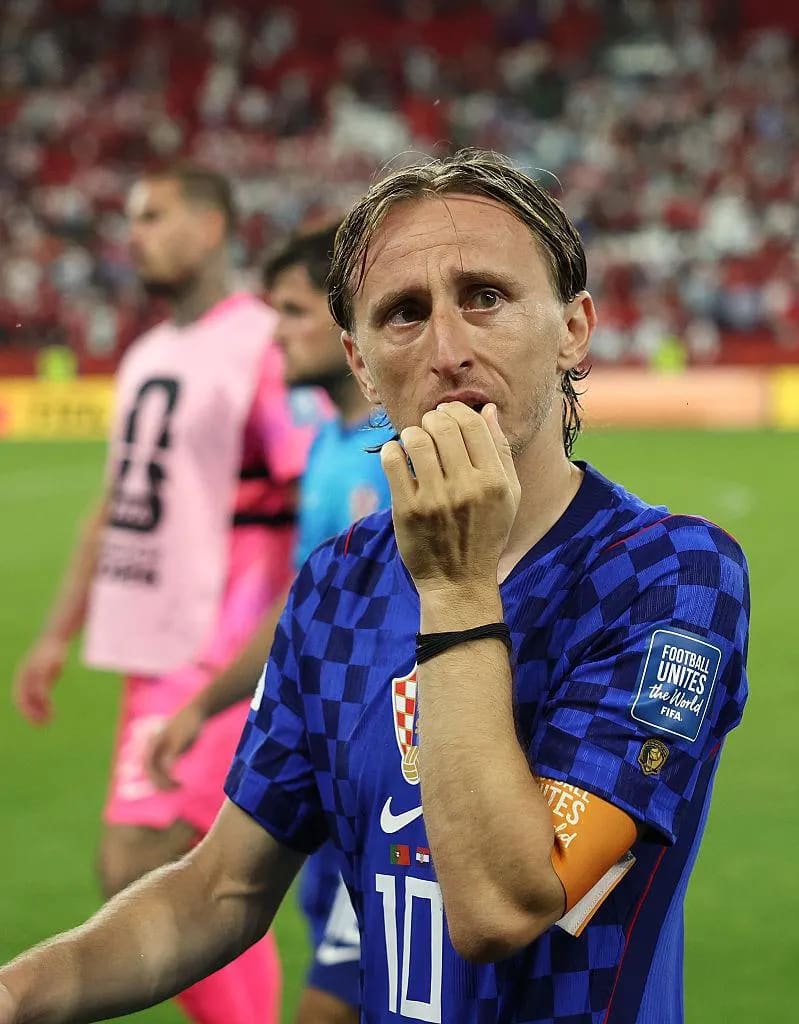
According to Reuters’ report on Modrić's reaction, the 40-year-old captain criticised Croatia's lack of aggression, unity and fighting spirit after a result that replaced the 6–0 defeat to Spain in 2018 as the country's worst ever.
Losing to England was one thing.
Losing like this was something else.
And for a Croatian side whose international reputation has been built around resilience, discipline and an almost irrational refusal to accept defeat, the manner of Saturday's collapse was perhaps even more alarming than the seven goals.
The question now goes beyond one Nations League result.
Are we finally watching the end of Croatia's extraordinary Modrić era?
7–0 Was Not Just Another Heavy Defeat
Every great national team eventually has a night when the illusion of permanence disappears.
Croatia may have experienced theirs in Rijeka.
England did not scrape past them.
They overwhelmed them.
Thomas Tuchel's side attacked with pace, pressed aggressively and repeatedly exposed spaces that Croatia could not close.
The scoreline was historic.
Croatia's previous heaviest defeat had been 6–0 against Spain in 2018.
England went one better.
That alone would make the result significant.
But the context makes it more troubling.
Croatia's identity over the past decade has been built around their ability to survive difficult moments.
They rarely panic.
They rarely collapse.
Even when opponents appear stronger on paper, Croatia have repeatedly found ways to drag matches into uncomfortable territory.
Against England, that famous resistance disappeared.
Modrić's reaction therefore mattered.
He was not simply disappointed about losing.
He was questioning whether Croatia had displayed the qualities upon which their reputation had been built.
Modrić Has Been the Constant Through Croatia's Greatest Era
To understand why this moment feels different, you have to understand what Luka Modrić represents.
Players have come and gone.
Mario Mandžukić retired.
Ivan Rakitić retired.
Dejan Lovren moved on.
Marcelo Brozović ended his international career.
Generations have gradually changed around him.
Modrić remained.
The midfielder reached his 200th Croatia appearance during the 2026 World Cup, becoming only the fourth male footballer to reach that landmark at senior international level.
At 40, he was still influencing World Cup matches.
He helped Croatia progress from their group before their tournament ended with a 2–1 defeat to Portugal in the round of 32.
It was another tournament in which Croatia continued competing long after people had begun wondering whether their ageing core had reached the end.
That has become a familiar pattern.
Write Croatia off.
Watch Modrić control another midfield.
Predict the decline.
Watch Croatia survive again.
But eventually every sporting cycle ends.
The difficulty is recognising when it has actually begun.
Croatia Have Been Defying the Ageing Narrative for Years
Croatia's recent history makes declaring the end particularly dangerous.
This is a country that reached the 2018 World Cup final despite a population of fewer than four million people.
Four years later, when many expected the team to decline, Croatia finished third at the 2022 World Cup.
They then reached the 2023 UEFA Nations League final.
Again and again, Croatia have produced results that seemed disproportionate to the size of their talent pool.
Their success was never based entirely on athletic superiority.
It came from technical quality, midfield intelligence, tournament experience and extraordinary mental resilience.
And Modrić embodied almost all of it.
That is why Croatia have been so difficult to bury.
Their greatest quality has often been knowing how to suffer.
Against England, however, they didn't suffer successfully.
They unravelled.
The Most Concerning Problem Was Not Modrić's Age
It would be easy to make this entirely about a 40-year-old midfielder.
That would also be too simplistic.
Modrić was not the reason Croatia conceded seven goals.
Croatia's problems were collective.
England's movement repeatedly pulled their defensive structure apart.
Their midfield could not consistently slow England's transitions.
The defensive line struggled with the speed and variety of England's attacking combinations.
And once the game began escaping them, Croatia failed to regain control.
That matters because replacing Modrić alone will not solve those problems.
The transition Croatia face is much bigger.
They are trying to move from one extraordinary generation into another competitive team without losing the characteristics that made the first one successful.
That is one of the hardest jobs in international football.
The Old Core Is Gradually Disappearing
For years, Croatia could depend on a recognisable spine.
Modrić.
Rakitić.
Brozović.
Perišić.
Kovačić.
That midfield and surrounding experience gave Croatia extraordinary control in tournament football.
The picture is now changing.
Rakitić and Brozović are no longer part of the international setup.
Modrić is 40.
Ivan Perišić remains involved but belongs to the same veteran generation.
Mateo Kovačić provides experience, but Croatia increasingly need younger players to assume greater responsibility.
That transition was always coming.
The question was whether Croatia could manage it gradually enough that nobody noticed.
The 7–0 defeat suggests the process may become much more uncomfortable.
But Croatia's Next Generation Is Not Empty
This is important.
Croatia are not facing a talent crisis.
There are promising players already moving into significant roles.
Joško Gvardiol has become one of Europe's leading defenders and should be a foundation of Croatia's next cycle.
Petar Sučić represents part of the midfield succession plan.
Luka Sučić offers technical quality and creativity.
Martin Baturina has the ability to operate between midfield and attack.
Luka Vušković gives Croatia another highly rated young defensive option.
There are others.
The problem is not whether Croatia can produce good footballers.
Their development system has repeatedly proved that it can.
The challenge is replacing something much harder to manufacture:
generational leadership.
You Cannot Simply Produce Another Luka Modrić
This is where Croatia's transition becomes uniquely difficult.
Replacing Modrić does not mean finding another central midfielder.
It means replacing several functions simultaneously.
The player who receives the ball when everyone else is nervous.
The player who dictates tempo.
The captain teammates look towards when a match becomes chaotic.
The footballer capable of slowing a game down without making Croatia passive.
The symbol connecting different generations of the national team.
Those qualities are not transferred automatically when the No.10 shirt eventually changes hands.
Croatia may produce another outstanding midfielder.
Producing another Modrić is a different proposition.
Perhaps impossible.
And that means the next Croatian team cannot simply attempt to recreate the previous one.
It may need a new identity.
Petar Sučić and Baturina Must Eventually Become More Than Prospects
The transition will depend heavily on players such as Petar Sučić and Martin Baturina.
Young players are often discussed in international football as future solutions.
Eventually, the future arrives.
For Croatia, that moment is getting closer.
Petar Sučić has already shown that he can contribute on major stages.
During the 2026 World Cup, he scored in Croatia's 2–1 group-stage victory over Ghana.
Baturina, meanwhile, has been gradually introduced into a midfield that for years offered very little room for newcomers.
Both possess technical ability.
Both understand Croatian football's emphasis on midfield intelligence.
But succeeding Modrić's generation requires more than talent.
They must eventually take ownership of matches.
That is the difference between being a promising international and becoming the foundation of a national team.
Gvardiol May Become the Face of the Next Croatia
If Modrić represents Croatia's past and present, Joško Gvardiol may be the clearest symbol of their future.
He already has elite-level experience.
He has played at major tournaments.
He is comfortable defending large spaces.
He can progress possession.
And unlike several members of Croatia's veteran core, he should remain central to the national team for years.
That could eventually change where Croatia's leadership comes from.
For much of the Modrić era, the team's personality flowed through midfield.
The next version of Croatia may be built differently.
Perhaps around Gvardiol's defensive leadership.
Perhaps around a younger, more athletic midfield.
Perhaps with greater emphasis on transitions rather than prolonged midfield control.
The important thing is accepting that evolution may be necessary.
Trying to reproduce the Modrić era indefinitely could become more damaging than allowing it to end.
Zlatko Dalić Faces One of His Most Difficult Decisions
The transition is not only about players.
It is also about the manager.
Zlatko Dalić has overseen the greatest period in Croatian football history.
His achievements deserve enormous respect.
But managing a golden generation and rebuilding after one are two different challenges.
Dalić now has to balance loyalty with renewal.
Move too quickly and Croatia risk discarding experience they still need.
Move too slowly and younger players remain supporting characters instead of becoming leaders.
That balance becomes even more difficult when the veteran at the centre of the conversation is still capable of contributing.
Modrić has repeatedly shown that age alone cannot determine his usefulness.
So the question cannot simply be:
Is Modrić too old?
The better question is:
Can Croatia build the next team while Modrić is still part of the current one?
Spain Could Not Arrive at a Worse Time
Croatia have almost no time to process the humiliation.
Their next opponent is Spain.
According to UEFA's official Nations League information, Croatia face the world champions on October 6.
And Spain have already beaten Croatia 4–1 during this Nations League campaign.
Now Croatia must face them immediately after conceding seven against England.
It is difficult to imagine a more severe examination.
Spain have just demonstrated their extraordinary depth by making nine changes and still defeating Czechia 3–1.
Beyond the Final Whistle analysed that strength in our recent article, Spain Changed Nine Players and Still Won — Do the World Champions Have Football’s Deepest Squad?.
Croatia now face the opposite challenge.
They need to prove that one catastrophic result has not destroyed theirs.
The Spain Match Is About More Than Three Points
Croatia need a response.
Not necessarily because one Nations League result will determine the future of the national team.
But because of what Modrić said after the England defeat.
Aggression.
Unity.
Fighting spirit.
Those characteristics have been fundamental to Croatia's reputation.
Spain may dominate possession.
They may create chances.
They may even win.
But Croatia cannot allow another match to unfold with the same sense of helplessness.
That is why the Spain game could tell us more than the table does.
The response matters.
Does Croatia retreat psychologically after 7–0?
Or does humiliation trigger the defiance that has defined this generation?
Modrić has demanded the latter.
Now his teammates must produce it.
One Defeat Does Not Erase Croatia's Golden Era
Perspective is important.
Nothing that happened in Rijeka changes what Croatia have accomplished.
A World Cup final.
Another World Cup podium.
A Nations League final.
Years competing against countries with dramatically larger populations and deeper talent pools.
Croatia's achievements belong among international football's great modern stories.
Seven goals cannot erase them.
But sporting history does not guarantee sporting future.
Eventually reputations have to be rebuilt by different players.
That may be the real significance of the England defeat.
Not that Croatia's past suddenly looks less impressive.
But that their future suddenly looks more urgent.
Is This Really the End? Croatia Have Heard That Before
There is also a reason for caution before writing Croatia's obituary.
People have done it before.
After 2018, the team was supposedly too old.
After key retirements, the midfield was supposedly finished.
Before 2022, another deep World Cup run seemed unlikely.
Croatia responded by reaching the semi-finals.
Even during the 2026 World Cup, Modrić continued producing performances that made discussions about his age feel almost irrelevant.
This team has built a career out of embarrassing premature predictions of its decline.
Perhaps 7–0 will become another moment they use as motivation.
Perhaps they respond against Spain and restore confidence.
Perhaps Modrić has another chapter left.
But for the first time in a long time, Croatia's biggest question may not be how much longer their golden generation can survive.
It may be whether the next generation is ready to stand without it.
Croatia Must Prepare for Life After the Impossible
Modrić cannot play forever.
Croatia know that.
Their supporters know it.
His teammates know it.
The uncomfortable part is accepting that replacing him will require more than selecting another midfielder.
For two decades, Luka Modrić has represented Croatia's footballing intelligence, resilience and refusal to recognise supposed limitations.
He reached 200 international appearances because he survived generation after generation.
But the ultimate test of Croatia's football system will come when he is no longer there to rescue it.
The 7–0 defeat to England may eventually be remembered simply as one terrible night.
Or it may become the moment when Croatia realised the transition could no longer be postponed.
Spain will provide the first indication.
The years after Modrić will provide the real answer.
Beyond the Final Whistle, Croatia's record 7–0 defeat should not erase one of international football's greatest modern eras, but it should force an uncomfortable conversation about what comes next. Luka Modrić has spent two decades helping Croatia defy football's natural cycle; now the challenge is ensuring that Gvardiol, Sučić, Baturina and the next generation inherit more than memories of that success. The golden era does not have to end in collapse — but Croatia must begin building what follows it.
Was the 7–0 defeat to England simply a disastrous night, or are we finally watching the closing chapter of Croatia's extraordinary Modrić era? Join the conversation on Beyond the Final Whistle.