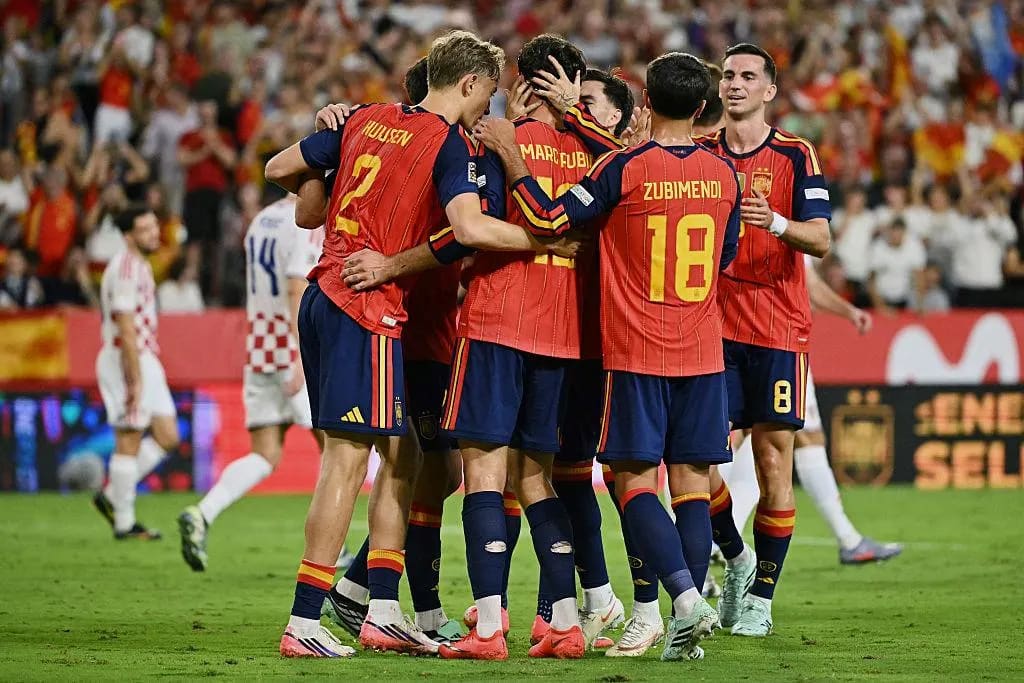
Luis de la Fuente made nine changes to Spain’s starting XI against Czechia and still watched the world champions win 3–1. The result was another reminder that Spain’s greatest weapon may no longer be just their superstar names — it may be a system capable of surviving almost any personnel change.
Category: International Football / Tactical Analysis
Date: October 4, 2026
By Abiodun Adewale Adeniyi | Founder & Editor, Beyond the Final Whistle
October 4, 2026 | UEFA Nations League
Nine changes.
Same result.
Spain followed their emphatic 4–1 victory over Croatia by changing almost their entire starting XI against Czechia on Saturday night — and still walked away from Oviedo with another victory.
Lamine Yamal opened the scoring after only six minutes. Captain Rodri added the second before Jiri Slama briefly gave Czechia hope, and Mikel Merino eventually completed a 3–1 victory after the visitors were reduced to 10 men.
The result left Spain with a perfect nine points from their opening three UEFA Nations League matches, three points ahead of England in Group A3. According to Reuters’ report on Spain’s victory, Luis de la Fuente made an extraordinary nine changes from the team that had beaten Croatia 4–1 only days earlier.
Only Lamine Yamal and Álex Baena remained in the starting XI.
Yet Spain still looked recognisably like Spain.
That raises a fascinating question.
Do the world champions now possess the deepest national-team squad in football?
Nine Changes, But Spain’s Identity Remained
Heavy rotation normally changes the character of a national team.
International managers have limited training time compared with club coaches, meaning combinations and familiarity can be particularly important.
Change nine players and some disruption would normally be expected.
Spain showed why they are different.
David Raya replaced Unai Simón in goal.
Iván Fresneda came into the defence alongside Robin Le Normand, Aymeric Laporte and Fran García.
Rodri returned to anchor the midfield alongside Pedri, with Dani Olmo operating further forward.
Roberto Fernández was trusted to lead the attack.
And yet Spain continued to dominate possession and manipulate spaces with the same basic principles that have become familiar under De la Fuente.
That is what makes this team so difficult to prepare for.
Opponents are not simply preparing to stop eleven players.
They are preparing to stop a footballing structure.
Lamine Yamal May Be the Superstar — But Spain Are Not Dependent on One Man
There is no escaping Lamine Yamal’s influence.
The 19-year-old produced another spectacular moment against Czechia, curling a left-footed strike into the top corner from the edge of the penalty area after only six minutes.
It continued an extraordinary run of form for Spain.
But the danger when discussing Yamal is allowing his individual brilliance to obscure what is happening around him.
Spain have one of world football’s most devastating attacking talents.
They are not, however, structured entirely around him.
That distinction matters.
Yamal can beat defenders individually, create overloads and produce goals that tactical organisation cannot manufacture.
But behind him Spain still have Rodri controlling midfield, Pedri manipulating spaces, Dani Olmo finding pockets between the lines and a collection of wide players and midfielders capable of changing the rhythm of a match.
Against Czechia, Spain demonstrated the other side of their strength.
They can change the supporting cast without abandoning the structure.
Rodri Changes the Temperature of a Match
Rodri’s return to the starting XI offered another reminder of why he remains so important.
Spain’s captain scored the second goal, converting a rebound inside the area for his first international goal in more than two years.
But evaluating Rodri only through goals misses almost everything that makes him valuable.
His greatest strength is control.
He determines when Spain accelerate.
He determines when they recycle possession.
He positions himself to stop transitions before they develop.
And because Spain are comfortable committing players ahead of the ball, having a midfielder capable of reading danger behind those attacks becomes essential.
That allows players such as Pedri and Olmo to operate higher.
It allows the full-backs to advance.
It allows Yamal to remain aggressive.
Spain’s attacking freedom is partly built on the security Rodri provides behind it.
And yet even Rodri is not Spain’s only option in that position.
Martín Zubimendi has become an elite midfielder in his own right.
That is where the depth conversation becomes serious.
Most countries would build their midfield around either Rodri or Zubimendi.
Spain can select between them.
Look at Spain’s Midfield Options
This may be the deepest area of the squad.
De la Fuente currently has access to combinations involving Rodri, Pedri, Martín Zubimendi, Fabián Ruiz, Mikel Merino, Dani Olmo, Fermín López and Álex Baena.
That is not simply numerical depth.
Those players offer different profiles.
Rodri provides control.
Zubimendi can dictate from deeper positions.
Pedri excels at receiving under pressure and connecting phases of possession.
Merino offers physical presence and late runs into the penalty area.
Olmo provides creativity between the lines.
Baena brings energy and progression.
Fermín offers direct running and goal threat.
Fabián provides another technically secure midfielder capable of controlling possession.
It means De la Fuente can alter the character of Spain’s midfield without completely changing the team’s football.
Few national coaches possess that luxury.
Spain’s Defensive Rotation Was Just as Impressive
The nine changes were not limited to midfield and attack.
Spain also changed most of their defence.
Dean Huijsen and Marc Cucurella were rested after playing the full match against Croatia.
Against Czechia, De la Fuente instead used Fresneda, Le Normand, Laporte and Fran García in front of Raya.
The official UEFA Nations League match information demonstrates the depth of options available to Spain throughout this campaign.
Huijsen, Le Normand and Laporte provide several centre-back combinations.
Cucurella and Fran García offer different characteristics on the left.
Fresneda and Marc Pubill add alternatives on the right.
And Spain managed that rotation while continuing to control large periods of the game.
It wasn't perfect.
Czechia did threaten during the second half and Slama’s goal reduced Spain’s advantage.
But that actually strengthens the analysis.
Spain’s second unit does not have to be flawless to demonstrate exceptional depth.
It only has to show that the drop from the first-choice XI is significantly smaller than it is for most international teams.
Luis de la Fuente Is Managing Minutes, Not Just Picking Teams
There is another reason behind the rotation.
This international window is unusually demanding.
Teams can play four Nations League matches in close succession during FIFA’s new extended September–October window.
De la Fuente is therefore trying to win matches while protecting players.
After the Czechia victory, the Spain coach emphasised that player health was part of his thinking and said he was carefully managing minutes ahead of the next game.
That is increasingly important because the current international calendar is forcing national-team managers to think differently about squad management.
Rather than asking the same eleven or fourteen players to carry the team through four matches, De la Fuente is treating his squad as something closer to two competitive starting XIs.
That only works, however, when the alternatives are good enough.
Spain’s are.
Even Injuries Are Creating New Opportunities
Spain have not reached this point with a completely healthy squad either.
Ferran Torres was recently forced to leave the national-team camp because of persistent discomfort in his left ankle.
That could have weakened Spain’s attacking options.
Instead, it created an opportunity for Carlos Espí.
Beyond the Final Whistle covered the situation in our Ferran Torres injury and Carlos Espí call-up report.
Espí earned his senior call after scoring five goals and providing two assists in Spain Under-21s’ 13–0 victory over San Marino.
He is not yet an established senior international.
But his emergence illustrates something important about Spain.
The depth does not end with the players currently receiving senior minutes.
There is another generation underneath them.
That pipeline may be Spain’s greatest long-term advantage.
Spain Are Producing Players for a System
This is where the story becomes bigger than one talented squad.
Spain’s success is not simply the result of assembling exceptional footballers at the same moment.
There is continuity in the type of football those players understand.
Many Spanish players arrive at senior international level already comfortable receiving the ball under pressure.
They understand positional occupation.
They understand how to create passing triangles.
They understand when to play through midfield and when to stretch the pitch.
They understand pressing immediately after losing possession.
That reduces the adaptation required when a new player enters De la Fuente’s team.
The individual may change.
The principles remain.
That is why nine changes do not necessarily produce nine new tactical problems.
Is Spain’s Second XI Good Enough to Compete With Elite Nations?
This is where the depth argument becomes fascinating.
Imagine removing several first-choice Spanish players.
No Unai Simón.
No Huijsen.
No Cucurella.
No Zubimendi.
No Fabián.
No Oyarzabal.
Spain could still potentially field a side containing Raya, Laporte, Le Normand, Rodri, Pedri, Olmo and Yamal.
That is not traditional backup depth.
That is another elite-level team.
And it gives De la Fuente options that become especially valuable during tournaments.
World Cups and European Championships are rarely won by only eleven players.
Injuries happen.
Suspensions happen.
Form changes.
Matches go to extra time.
Different opponents demand different tactical solutions.
The deeper a squad goes into a tournament, the more valuable the 15th, 18th and 22nd players become.
Spain appear unusually well prepared for that reality.
How Does Spain’s Depth Compare With England?
England provide the obvious comparison.
Thomas Tuchel also possesses an extraordinary collection of attacking talent.
Harry Kane.
Jude Bellingham.
Bukayo Saka.
Cole Palmer.
Anthony Gordon.
Morgan Rogers.
Declan Rice.
And England’s remarkable 7–0 victory over Croatia demonstrated just how destructive that talent can become when the combinations work.
England may even have greater individual depth in certain attacking positions.
But Spain currently appear to possess something England are still developing:
system depth.
There is a difference between having many excellent players and having many excellent players who can enter the same tactical structure without disrupting it.
England are still working through questions such as where Bellingham operates, how Palmer fits alongside him and which combinations best support Kane.
Spain’s roles appear more established.
That does not automatically make Spain’s players individually better.
It makes their depth easier to use.
And What About France?
France must also be part of the conversation.
Few countries can rival the sheer athleticism, technical quality and number of elite players available to the French national team.
France can lose world-class players and still field a side packed with Champions League-level talent.
Their talent pool may be among the deepest in world football.
But again, Spain’s advantage is not simply the number of players.
It is continuity.
The question is therefore not:
Which country has the most famous substitutes?
The better question is:
Which country can replace the greatest number of starters while changing the least about how the team functions?
Right now, Spain have an extremely convincing case.
The Czechia Match Also Showed Spain Are Not Invincible
There should still be some caution.
Spain were excellent in the first half against Czechia.
The second half was less convincing.
Slama pulled one back in the 69th minute, and the visitors briefly threatened to turn what had looked like a comfortable evening into a difficult finish.
De la Fuente acknowledged afterwards that Spain lost some continuity following the changes.
That matters.
Squad depth does not eliminate the importance of chemistry.
Rotating heavily will inevitably affect rhythm.
And against stronger opponents, periods of reduced control can become much more dangerous.
Czechia were eventually reduced to 10 men before Merino sealed the game.
Spain therefore should not interpret the 3–1 scoreline as evidence that any combination of players will automatically dominate.
The margins at international level remain small.
Croatia Will Test the Theory Again
Spain now travel to face Croatia on October 6.
According to UEFA’s official Nations League information, it will be Spain’s fourth match of the extended international window.
That makes the fixture particularly interesting.
De la Fuente has already rotated heavily.
He has already managed minutes.
Now he must decide how much to change again.
Spain have nine points from nine.
Another victory would complete a perfect four-match window.
But the bigger test may be physical rather than mathematical.
Can Spain maintain their intensity after four games in such a short period?
And can their depth continue protecting them from the workload problems affecting other national teams?
Those questions will tell us even more about the strength of this squad.
Spain’s Greatest Strength May Be Bigger Than Their Starting XI
Lamine Yamal will receive the headlines.
Rodri will control games.
Pedri will produce moments of technical brilliance.
And Spain’s biggest names will understandably dominate discussion around the world champions.
But international tournaments are rarely decided only by superstars.
They are decided by squads.
That may be where Spain are becoming truly frightening.
Nine changes against Czechia should have made them look like a different team.
Instead, they still looked like Spain.
The players changed.
The passing patterns remained.
The positional principles remained.
The confidence remained.
And most importantly, the winning continued.
Beyond the Final Whistle, Spain’s 3–1 victory over Czechia was more than another three points for the world champions. Luis de la Fuente changed nine starters and demonstrated something potentially more important than the strength of his best XI: Spain have built a footballing identity that survives rotation. England and France may possess equally extraordinary collections of talent, but Spain’s ability to replace players without replacing their principles could prove to be their greatest advantage when the biggest tournaments are decided.
Do Spain currently have the deepest national-team squad in world football, or would you put England or France ahead of them? Join the conversation on Beyond the Final Whistle.