
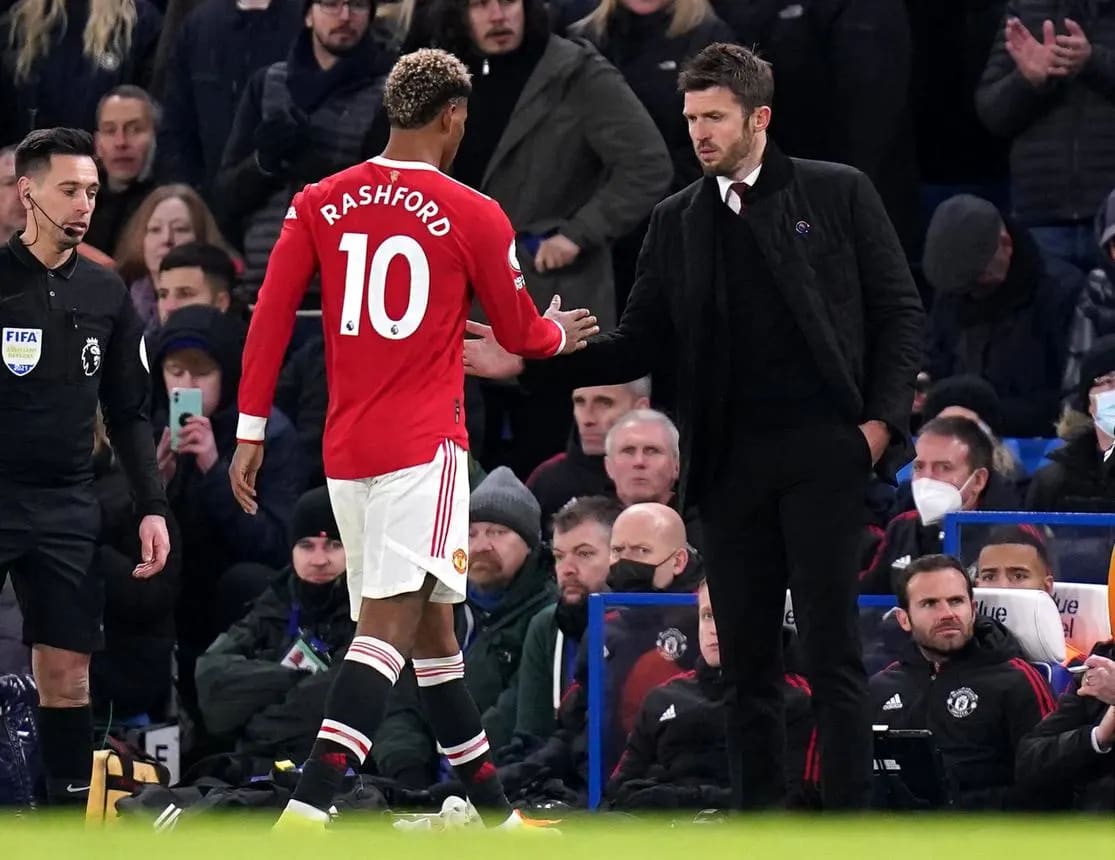
Manchester United's difficult start to the 2026/27 season has taken another worrying turn, with new physical-performance data placing Michael Carrick's side bottom of the Premier League across several key running metrics. Beyond the numbers, the statistics raise a bigger tactical question: why does a team built to return to the elite appear to be playing without elite-level intensity?
By Abiodun Adewale Adeniyi | Founder & Editor, Beyond the Final Whistle
September 23, 2026 | Premier League Analysis
Manchester United entered the new season expecting to build on the progress made under Michael Carrick last term.
Instead, five Premier League matches have produced just five points, and the latest numbers provide another indication of why the campaign has started so poorly.
According to Reuters, citing GeniusIQ data reported by Sky Sports, United rank 20th in the Premier League for distance covered at high intensity, time spent at high intensity, total sprints and time spent sprinting.
That is not simply an uncomfortable statistic.
For a club attempting to compete near the top of the Premier League, it raises questions about pressing, defensive transitions, movement without the ball and the overall physical identity of Carrick's team.
The Numbers Behind Manchester United's Problem
The four categories are particularly revealing:
High-intensity distance — 20th
Time at high intensity — 20th
Total sprints — 20th
Time spent sprinting — 20th
These statistics do not automatically mean Manchester United's players are unwilling to work. Running data needs tactical context: teams that control possession differently, defend in different blocks or press at different moments can naturally produce different physical profiles.
But finishing bottom across several related intensity measurements is difficult to ignore, especially when the results on the pitch are also disappointing.
United have taken only five points from their opening five Premier League games. Their latest result was a 1–1 draw against Fulham at Craven Cottage, where Matheus Cunha's late deflected equaliser prevented a third consecutive defeat in all competitions, as detailed in Reuters' match report.
The problem therefore appears bigger than one poor afternoon.
Fulham Exposed the Lack of Urgency
There were moments against Fulham when Manchester United looked dangerous.
Carrick's side registered 29 attempts compared with Fulham's 12, according to the Reuters report on the 1–1 draw, yet large periods of the performance lacked the urgency expected from a team chasing victory.
Former Manchester United captain Gary Neville was particularly critical of a spell early in the second half. His criticism was also reported in Reuters' analysis of United's league-worst running figures.
United eventually recovered.
After Lisandro Martínez's unfortunate own goal put Fulham ahead, Cunha's 89th-minute effort took a deflection and rescued a point.
But the equaliser should not obscure what happened before it.
A team can dominate the shot count and still lack intensity. Possession, attempts and territory tell us what happened with the ball; sprinting and high-intensity data can help reveal what happened away from it.
And that may be where Carrick's biggest problem lies.
Why Running Matters Tactically
Modern elite football is not simply about running more kilometres than the opposition.
It is about running at the right moments.
When a press is triggered, several players have to move aggressively together. If the first attacker presses but the midfield does not follow, opponents can play through the pressure.
When possession is lost, midfielders and defenders must react quickly enough to stop the counterattack.
When possession is regained, forwards need explosive movements to stretch the defensive line and create passing lanes.
That means United's poor high-intensity numbers potentially affect several phases of their game.
A lack of coordinated sprinting can make a press ineffective. Slow defensive reactions can expose space between midfield and defence. Limited attacking runs can also leave the player in possession without enough progressive options.
This is why the GeniusIQ numbers matter beyond fitness.
They potentially point toward a tactical problem as much as a physical one.
It is also why this story connects naturally with the tactical identity issues we previously examined in our analysis of Manchester United's current crisis.
Carrick's Early-Season Momentum Has Disappeared
The contrast with last season is significant.
Carrick initially replaced Ruben Amorim on an interim basis and eventually guided United to a third-place Premier League finish, returning the club to the Champions League. Reuters reported that United won 12 of Carrick's 17 league matches after he took charge last season.
That created genuine optimism entering 2026/27.
But the momentum has vanished.
United have managed only one Premier League victory in their opening five matches, while their struggles were compounded by a League Cup elimination against Brighton. The mounting pressure on Carrick before the Fulham game was examined by Reuters ahead of the fixture.
This is therefore Carrick's first significant test after the initial success of his tenure.
Opponents have had more time to study his Manchester United side. Expectations have risen. And now Carrick has to demonstrate that his team can evolve when the original momentum disappears.
Is This Fitness, Tactics or Mentality?
That is the most important question.
It would be too simplistic to look at the running statistics and conclude that United's players simply aren't trying.
Physical output is heavily influenced by tactical instructions.
A manager determines where the press begins, how aggressively the defensive line pushes forward, when midfielders jump toward opponents and how quickly players are expected to transition after turnovers.
If those instructions are unclear—or if different parts of the team react at different speeds—the collective intensity falls apart.
United therefore need to determine whether their numbers are primarily the consequence of physical conditioning, tactical structure, decision-making or some combination of all three.
Whatever the answer, being 20th across four major high-intensity categories cannot become normal for a club with Champions League ambitions.
The International Break Comes at the Right Time
Carrick now has something every struggling manager wants: time on the training ground, albeit without the players away on international duty.
As we explained in our recent feature on why the 2026 international break is unusually long, FIFA's revised calendar has created a longer September-October international window.
The Premier League's official international-break schedule confirms that the window runs from September 21 to October 6, with Premier League football returning on the weekend beginning October 10.
That gives Carrick an opportunity to reassess the structure of his team.
The solution should not simply be telling his players to “run more.”
United need more coordinated pressing, quicker reactions after losing possession and greater off-ball movement when attacking.
Intensity without organisation is wasted energy.
Organisation without intensity makes a team passive.
Carrick needs both.
Tottenham Could Tell Us Much More
Manchester United's first Premier League match after the break is against Tottenham Hotspur at Old Trafford on October 10.
The result will obviously matter, but the performance should tell us more about whether Carrick has addressed the underlying problems.
Are United pressing together?
Are midfielders closing spaces more aggressively?
Are forwards making repeated runs beyond the defence?
And when possession changes hands, how quickly does the team react?
Those details may tell us considerably more than possession percentages or total passes.
United's season is only five league matches old. There is plenty of time to recover.
But early warning signs should not be ignored simply because they arrive early.
The numbers have identified a weakness.
Now Carrick has to fix it.
Beyond the Final Whistle, Manchester United's running statistics do not prove that effort alone is responsible for their difficult start, but finishing bottom of the Premier League across four high-intensity measures is a warning Carrick cannot dismiss. United's next step must be turning physical output into coordinated tactical intensity—because competing at the top of the Premier League requires both quality on the ball and urgency without it.
Can Michael Carrick use the international break to restore Manchester United's intensity, or do these numbers point to a deeper tactical problem at Old Trafford? Join the conversation on Beyond the Final Whistle.


