
Author: Abiodun Adewale Adeniyi | Founder & Editor, Beyond the Final Whistle
Date: September 20, 2026
For years, set pieces occupied an awkward position in football.
Managers knew corners and free-kicks mattered. Teams practised them. Supporters understood that one accurate delivery could change a match.
But they were often treated as something separate from the sophisticated tactical work associated with open play.
That era is disappearing.
Across the Premier League, corners, free-kicks, throw-ins and even kick-offs are increasingly being treated like carefully designed attacking possessions.
Runs are rehearsed.
Blocking movements and decoy runs are coordinated.
Delivery zones are analysed.
Opponents' weaknesses are studied.
And specialist coaches are being employed to find advantages in situations that might last only a few seconds.
The numbers explain why.
During the 2025/26 campaign, set pieces became one of the defining tactical trends in English football. Opta's analysis of Premier League tactical trends found that at one stage of the season 28.3% of league goals had come from corners, free-kicks or throw-ins, excluding penalties—well above the levels recorded in the preceding campaigns.
This isn't simply about having a tall centre-back and somebody capable of delivering a good corner anymore.
The Premier League is experiencing a set-piece revolution.
And behind many of those carefully rehearsed routines are specialist coaches whose influence is becoming increasingly important.
From Afterthought to Tactical Weapon
Think about what makes a set piece different from open play.
During normal football, possession is unpredictable.
Players move constantly.
Defenders react.
Spaces open and disappear.
But when a team wins a corner, free-kick or throw-in, there is a brief opportunity to create something much more controlled.
The attacking team knows where the ball will start.
It can determine where its players stand.
It can decide which runs will be made.
It can target a particular defender.
And crucially, it can practise the same situation repeatedly on the training ground before the opposition ever sees it.
In a sport increasingly decided by tiny margins, that's enormously valuable.
A Premier League team might spend 70 minutes struggling to break down a compact defence.
Then it wins one corner.
Ten seconds later, the match could be 1-0.
That's why the best clubs no longer treat these moments as bonuses.
They're treating them as designed scoring opportunities.
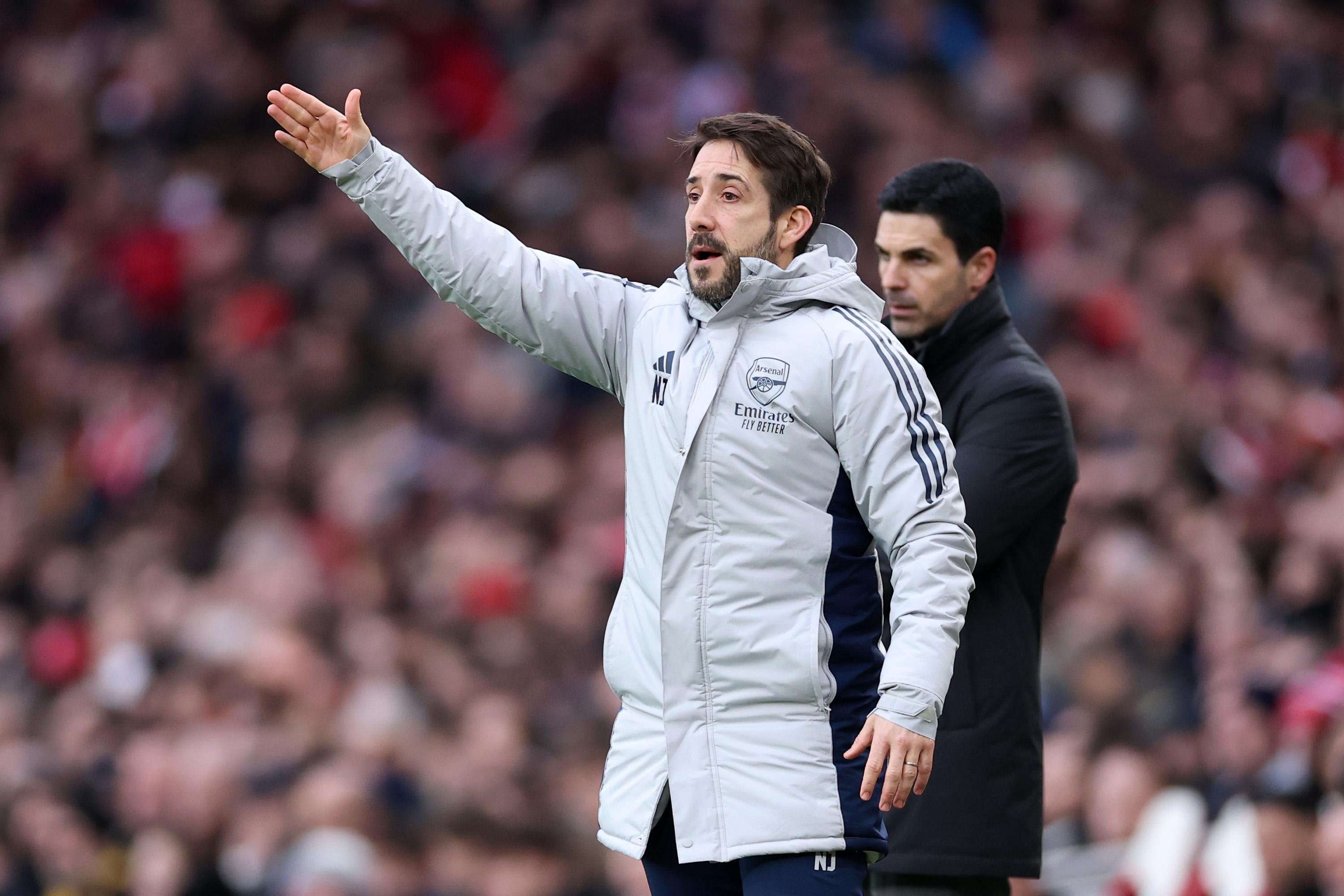
Nicolas Jover and Arsenal: The Premier League Blueprint
No discussion of the modern set-piece revolution can begin anywhere other than Arsenal.
And particularly Nicolas Jover.
Jover joined Mikel Arteta's coaching staff in 2021 after previously working at Manchester City, and his influence on Arsenal's set pieces has become one of the most recognisable features of the team's tactical identity.
The improvement has been dramatic.
The Premier League's tactical analysis of Nicolas Jover's impact showed that Arsenal became the league's leading team for goals from corners after his arrival. It also highlighted how Arteta views set pieces not as something separate from open-play football, but as another connected element of Arsenal's overall tactical structure.
That philosophy matters.
Arsenal don't simply swing hopeful crosses into the penalty area.
Their corners contain layers.
One player might attack the near post.
Another occupies a defender.
Another creates a blocking movement.
Several players may begin together before separating in different directions.
And then Gabriel Magalhães attacks the space created by those movements.
Why Gabriel Became Such a Dangerous Weapon
Gabriel provides perhaps the clearest example of how specialist coaching can maximise an individual player's attributes.
The Brazilian is physically powerful, excellent in the air and aggressive when attacking crosses.
But those qualities alone don't explain Arsenal's success.
The challenge is getting him into the right position.
That's where the routine comes in.
According to the Premier League's detailed breakdown of how Arsenal use Gabriel from corners, Jover's routines combine inswinging deliveries with coordinated movement designed to create favourable spaces for Arsenal's aerial threats.
The delivery is critical.
The movement is critical.
Gabriel's timing is critical.
And the actions of teammates who may never touch the ball are equally important.
That's the part supporters sometimes miss.
A player can contribute significantly to a set-piece goal without registering a goal, assist or even touching the ball.
His job may simply be to move a defender two metres away from the eventual scorer.
That's tactical design.
Arsenal's Corners Became Almost a Separate Attack
By the beginning of the 2025/26 season, Arsenal's advantage had become remarkable.
Sky Sports reported that Arsenal had scored 33 Premier League goals from corners since the beginning of 2023/24, while no other club had scored more than 20 over the same period. (skysports.com)
That gap cannot simply be dismissed as good fortune.
Opponents know what is coming.
They analyse Arsenal.
They practise defending Arsenal's corners.
They assign players specifically to Gabriel.
And Arsenal continue finding ways to create chances.
That is perhaps the strongest evidence of Jover's value.
A successful set-piece coach can't simply invent one brilliant routine.
Once opponents recognise it, they adapt.
The specialist must then create the next variation.
And the next.
And the next.
It's an ongoing tactical arms race.
Brentford: The Set-Piece Laboratory
Arsenal may have become the Premier League's most famous set-piece team, but Brentford deserve enormous credit for helping pioneer the specialist approach.
The west London club has long searched for marginal gains that can help it compete against teams with substantially larger financial resources.
Set pieces fit that philosophy perfectly.
For clubs unable to simply purchase another £80 million attacker whenever goals become difficult to find, better coaching can help reduce the gap.
Brentford have consistently built set pieces into their tactical identity, and that philosophy remains visible today.
The club's own analysis of Keith Andrews' first Premier League season describes set pieces as a key weapon, particularly highlighting Michael Kayode's long throws. Brentford also conceded only eight goals from corners, free-kicks and throws during the 2025/26 league campaign, the third-fewest in the division. (brentfordfc.com)
That's another important point.
A specialist set-piece coach isn't simply there to create goals.
Preventing them can be equally valuable.
Nicolas Jover's Brentford Connection
There is also an interesting connection between two of England's most influential set-piece clubs.
Before working at Manchester City and Arsenal, Jover spent time at Brentford.
That speaks to Brentford's willingness to invest in specialist thinking before it became fashionable across the Premier League.
The club has repeatedly worked with coaches and analysts dedicated to finding advantages from restarts.
And Brentford's appreciation of Arsenal's development has been public.
Before facing Arsenal in January 2025, then-Brentford head coach Thomas Frank described the Gunners as the best set-piece team in the world, highlighting both their aggressive approach and the quality of their coaching. (brentfordfc.com)
That's quite an endorsement from a club that knows the subject extremely well.
The Long Throw Is Back
Perhaps the most surprising part of the Premier League's set-piece revolution is the return of a weapon many people thought modern football had left behind.
The long throw.
For a generation of supporters, it immediately brings back memories of Rory Delap launching balls into the Stoke City penalty area.
For years, the tactic was sometimes portrayed as primitive.
Something associated with physical football rather than sophisticated tactics.
Modern coaches are reconsidering that assumption.
Because tactically, the logic is obvious.
A long throw allows a team to send the ball directly into the opposition penalty area from a stationary situation.
Why wouldn't a coach investigate whether it could be exploited?
And the increase has been enormous.
The Premier League's official analysis of the long-throw revival found that during the opening nine Matchweeks of 2025/26, all 20 Premier League clubs had attempted at least three throws of 20 metres or more into the opposition penalty area.
The league was averaging 3.99 long throws into the box per match, compared with just 1.52 in 2024/25.
That's an increase of around 162%.
This wasn't a minor tactical adjustment.
It was a league-wide change.
Brentford Took the Long Throw to Another Level
No club embraced the tactic more enthusiastically than Brentford.
Through those opening nine Matchweeks, Brentford had sent 47 long throws into opposition penalty areas, more than any other Premier League side.
Crystal Palace had 38.
Sunderland had 33.
Bournemouth had 30.
And Brentford had a particularly dangerous weapon in Michael Kayode. (premierleague.com)
The important point isn't simply the number of throws.
It's what happens after them.
A team can design movements around a long throw just as it would a corner.
One player attacks the first contact.
Another anticipates the flick-on.
Others position themselves for second balls.
Players outside the penalty area prepare either to recycle possession or stop the counterattack.
Suddenly a throw-in isn't merely a restart.
It's another rehearsed attacking sequence.
But Long Throws Aren't a Magic Formula
There is an important warning here.
More long throws don't automatically mean more goals.
Later Opta analysis found that although Premier League clubs were using them much more frequently, they remained relatively inefficient.
Across the first 301 league matches of 2025/26, Opta counted 1,179 long throws and 24 goals resulting from those situations—roughly one goal for every 49 long-throw attempts. (theanalyst.com)
That nuance is important.
The tactical revolution isn't about blindly launching the ball into the penalty area.
It's about identifying when, where and how a particular restart can create an advantage.
A poorly executed long throw is simply possession given away.
A carefully designed one can become a legitimate chance.
The specialist coach's job is understanding the difference.
Corners Are Becoming Designed Plays
Corners remain the most obvious example of the trend.
Consider everything a modern set-piece coach must analyse.
Where should the delivery land?
Should it be inswinging or outswinging?
Should players crowd the goalkeeper?
Which defender is the opponent's weakest aerial marker?
Does the opposition defend zonally?
Which attacker should make the first run?
Who attacks the second ball?
Who remains outside the penalty area?
Who protects against the counterattack?
What happens if the first delivery is cleared?
Those aren't random decisions.
They're components of a designed play.
That's why two corners that appear identical to supporters watching on television can actually contain completely different tactical instructions.
One may be designed to create a direct header.
Another could target the goalkeeper.
Another could aim for the far post and a knockdown.
Another may deliberately be played short to drag defenders away from their preferred positions.
The corner itself is merely the starting point.
Blocking, Decoys and Creating Space
One of the most interesting developments has been the increasing sophistication of movement inside the penalty area.
Attackers don't simply run toward the ball.
They manipulate defenders.
One player may deliberately move across a defender's path.
Another runs toward the near post knowing the ball isn't intended for him.
A third drags his marker away from the target zone.
Then the intended receiver attacks the newly created space.
The Premier League's analysis of Arsenal specifically highlights the importance of blocking movements, decoy runs and physical positioning in creating opportunities for Gabriel. (premierleague.com)
It is the set-piece equivalent of positional play.
Create movement.
Manipulate the defence.
Open the space.
Attack it.
The Goalkeeper Is Part of the Battle
Goalkeepers have also become central to modern corner strategy.
Teams increasingly study how an opposing goalkeeper behaves under pressure.
Does he aggressively attack crosses?
Does he remain on his line?
How comfortable is he moving through bodies?
Which delivery zones cause him problems?
How does his defensive unit protect him?
Those questions can determine an entire routine.
Attackers may position themselves around the six-yard box specifically to make the goalkeeper's route toward the ball more complicated without committing a foul.
That creates a difficult decision.
Come for the cross and risk becoming trapped in traffic.
Stay on the line and allow an attacker to challenge for the header.
The margins are tiny.
That's exactly where specialist coaches work.
Set Pieces Are an Analytics Problem Too
This revolution couldn't have happened without football's wider embrace of data.
Clubs now possess enormous amounts of information about opponents.
Analysts can investigate where a team concedes first contact from corners.
Which defender loses aerial duels.
Whether a goalkeeper struggles with inswinging deliveries.
Which zones produce the highest-quality chances.
How often the opposition leave players forward.
What happens after the first clearance.
Then video analysts add context.
Numbers identify the weakness.
Video shows how that weakness occurs.
The coaching staff then design a routine to attack it.
That is modern set-piece football.
Why Specialist Coaches Offer Extraordinary Value
There is also an economic argument.
Premier League clubs spend tens of millions of pounds searching for marginal improvements.
A specialist coach costs a fraction of the price of an elite player.
Suppose better set-piece work produces only four or five additional goals during a season.
Those goals could still produce several additional league points.
And a few points can determine whether a club:
wins the Premier League,
qualifies for the Champions League,
reaches Europe,
or survives relegation.
Viewed from that perspective, specialist coaching can potentially provide one of football's best returns on investment.
Defending Set Pieces Is Becoming Just as Sophisticated
Of course, there are two teams involved.
As attacking routines become more sophisticated, defensive systems must evolve too.
Teams have to choose between zonal marking, man-to-man marking or hybrid systems.
They need to protect their goalkeeper.
Recognise blockers.
Track late runners.
Win the first contact.
React to second balls.
And remain prepared to counterattack after regaining possession.
Sky Sports' analysis of attempts to stop Arsenal's corners illustrates the problem perfectly: opponents increasingly focus on disrupting Arsenal's timing and movement before players such as Gabriel can reach their preferred attacking zones. (skysports.com)
Every successful attacking innovation therefore creates a defensive response.
Then the attacking coach creates another variation.
That's the arms race.
Set Pieces Aren't “Anti-Football”
There remains a strange stigma around set-piece success.
When a team repeatedly scores from corners, some critics describe it as overly dependent on dead balls.
But why should a set-piece goal be considered less sophisticated than an open-play goal?
A successful corner can require:
precise delivery,
perfectly timed movement,
spatial manipulation,
physical execution,
opponent analysis,
and hours of training-ground preparation.
That's football coaching.
Teams are praised for rehearsing pressing triggers and positional rotations.
A rehearsed corner deserves the same tactical respect.
Football doesn't award two goals because a move contained 30 passes.
The scoreboard doesn't care how the ball went in.
Arsenal Show Set Pieces and Beautiful Football Can Coexist
This is perhaps the biggest lesson from Arsenal.
A team can play sophisticated possession football and still be devastating from dead balls.
The two ideas aren't contradictory.
They complement one another.
If an opponent defends deep to restrict Arsenal's open-play combinations, Arsenal may win more corners.
Those corners become another way of breaking the defensive block.
If defenders become terrified of conceding corners, that threat can even influence their decisions during open play.
Set pieces therefore become part of the team's broader attacking identity.
Arteta himself has explained that he doesn't view open play and set pieces as two completely separate things. The Premier League's analysis of Jover's work quotes Arteta explaining that the challenge was finding ways to connect set-piece work to Arsenal's wider football.
That's probably the best way to understand the revolution.
Set pieces are no longer a side project.
They're football.
What Comes Next?
The logical next stage is even greater specialisation.
Elite football already employs large coaching and analytics departments.
Why should set pieces stop with one specialist?
We could increasingly see coaches focusing specifically on attacking corners.
Others concentrating on defensive restarts.
Throw-in specialists.
Dedicated set-piece analysts.
Opponent-specific dead-ball scouting.
And specialists using tracking data to study the precise movements of players inside the penalty area.
The modern football coaching staff increasingly resembles a group of experts rather than one manager controlling every detail.
Set pieces fit naturally into that evolution.
The Premier League's Set-Piece Revolution Is Here to Stay
Football constantly evolves.
Pressing became more sophisticated.
Positional play transformed possession.
Analytics changed recruitment.
Goalkeepers became playmakers.
Full-backs started moving into midfield.
And now football is rediscovering something that has existed since the game's earliest days:
the restart.
Except this time, it comes with analysts, specialist coaches, rehearsed movement and enormous amounts of data.
The numbers demonstrate why clubs are paying attention.
At one stage of 2025/26, 28.3% of Premier League goals had come from non-penalty set pieces, according to Opta. (theanalyst.com)
Long throws surged.
Corner routines became increasingly elaborate.
Arsenal demonstrated how a specialist could help transform one phase of the game into a genuine competitive advantage.
Brentford showed how innovation can help clubs compete beyond their financial weight.
And the rest of the Premier League responded.
The secret weapon isn't particularly secret anymore.
Now the question is:
Who finds the next set-piece innovation first?
Beyond the Final Whistle, the Premier League's set-piece revolution shows how far elite football has moved beyond simply “putting the ball into the box.” Arsenal's Nicolas Jover, Brentford's long-throw innovation and the growing influence of specialist coaching have transformed restarts into carefully engineered attacking opportunities. In a league where tiny margins can separate champions from challengers and survival from relegation, the next decisive tactical advantage might begin with something as simple as a corner flag.
Are specialist set-piece coaches becoming as important to Premier League teams as traditional assistant managers—and which club currently has the smartest dead-ball strategy in England? Join the conversation on Beyond the Final Whistle.


