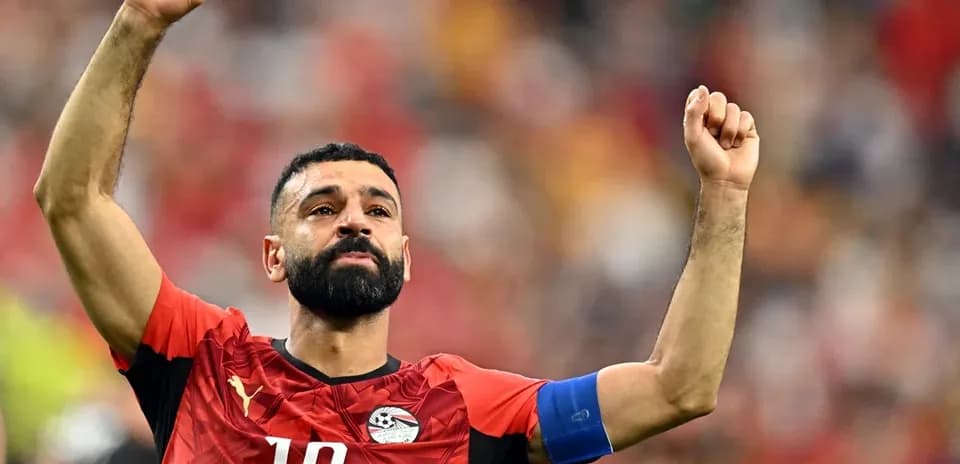
Mohamed Salah held up a sheet of paper with the number 70 on it in the Cairo dressing room on Friday night — but by Saturday morning, FIFA's own numbers said he had not broken Egypt's all-time scoring record after all.
The Egypt captain scored twice in the closing minutes of the 5-0 win over Malawi in the 2027 Africa Cup of Nations qualifiers, heading in a cross from substitute Ibrahim Adel six minutes from time and then converting a Panenka penalty deep in stoppage time after Hamza Abdelkarim had been brought down. The brace ended a four-match scoring drought for his country and sparked celebrations that suggested the record of Hossam Hassan — 69 international goals between 1985 and 2006 — had finally fallen.
Two counts, two different answers
By the Egyptian Football Association's count, Salah is now Egypt's outright top scorer. The EFA's figures credit him with 70 goals, one clear of Hassan, and several statistical outlets reported the milestone the same way on Friday night, including the French network Stats du Foot.
FIFA's records tell a different story. As AfricaSoccer explains, FIFA and Transfermarkt recognise only 68 goals for Salah — one behind Hassan. On that official count, he needs one more goal to draw level and two to stand alone at the top.
The confusion deepened because of FIFA itself. After Salah's goal against New Zealand at the 2026 World Cup, a report on FIFA's official website put him on 68 goals — a figure that, added to the Malawi brace, pointed to 70. As the controversy grew, FIFA corrected that report, amending Salah's tally in it from 68 down to 66 and admitting an error in the count. On FIFA's corrected numbers, the Malawi brace takes him to 68, not 70 — and Hassan's record stays intact.
The Swaziland friendly behind the gap
The two-goal difference is not new, and it is not a rounding error. It traces back to 2013, near the start of Salah's international career, when he scored twice in Egypt's 10-0 friendly win over Swaziland. Egypt's coach that day, Bob Bradley, made 10 substitutions — more than FIFA permits in a recognised full international, where matches involving more than six substitutions lose their official 'A' status.
That match never appeared in FIFA's official list of Egypt fixtures, and Salah's two goals in it were left out of his official international tally. The Egyptian FA and Egyptian media statistics count every senior match, which produces the 70 figure. Neither system counts the 10 goals Salah scored for Egypt's under-20, under-23 and Olympic teams.
There is an added edge to the dispute. Hassan is not a distant historical figure in this story: he was Egypt's head coach until he was sacked last week, amid reports of a rift with his captain after hauling Salah off an hour into the opening qualifier against Angola. Salah then missed the following match against South Sudan. Breaking the record of the coach he reportedly fell out with would have carried obvious symbolism — which is part of why the '70' photograph travelled so fast.
What Tuesday in Malawi now decides
The good news for Salah is that this argument has an expiry date. Egypt face Malawi again on Tuesday, away from home, in the fourth round of the qualifiers. One goal would level Hassan's 69 on FIFA's official count; two goals would put Salah beyond argument on every count that exists — EFA, FIFA and Transfermarkt alike.
At club level, the Trabzonspor forward keeps scoring as well, and his place in Egypt's history is not really in doubt: he was named in our Best African XI of All Time this week, and no Egyptian player of the modern era comes close to his combined club and country record. The only question left is the arithmetic — and arithmetic, unlike reputations, can be settled in 90 minutes.
Beyond the Final Whistle: a record should not need an asterisk and a calculator. Salah has been made to wait by a substitution rule from a friendly played 13 years ago, but that may prove to be a gift in disguise — when he scores the goals that end this debate on Tuesday, nobody will be able to argue them away, and a record broken beyond dispute is worth more than one announced by a dressing-room photograph.
Whose count should stand — the Egyptian FA's 70 or FIFA's 68? Tell us in the comments.